Blog
Whole-Home Generator Transfer Switches: What NC Homeowners Need to Know
Published
Category
Construction Guides
Power outages are a reality in North Carolina. This guide explains how transfer switches work, the difference between 200A and 400A+ systems, and what to expect during installation.
Anyone who has lived in North Carolina for more than a few years knows what a hurricane or severe ice storm can do to the power grid. Outages that last days — or in extreme cases, weeks — aren't a theoretical possibility; they're a periodic reality for homeowners across the Fayetteville area and the broader coastal plain region. A whole-home standby generator with a properly installed transfer switch is the most reliable solution, and understanding how transfer switches work helps you make the right choice for your home's electrical capacity.
What Is a Transfer Switch and Why Does It Matter?
A transfer switch is the critical safety component that allows a generator to power your home's electrical system without back-feeding into the utility grid. Back-feeding — allowing generator power to flow backward through your meter into the utility lines — is extremely dangerous. It can electrocute linemen working to restore power and can destroy your generator when utility power returns. This is why a properly installed transfer switch isn't optional; it's required by code and by utility companies in North Carolina.
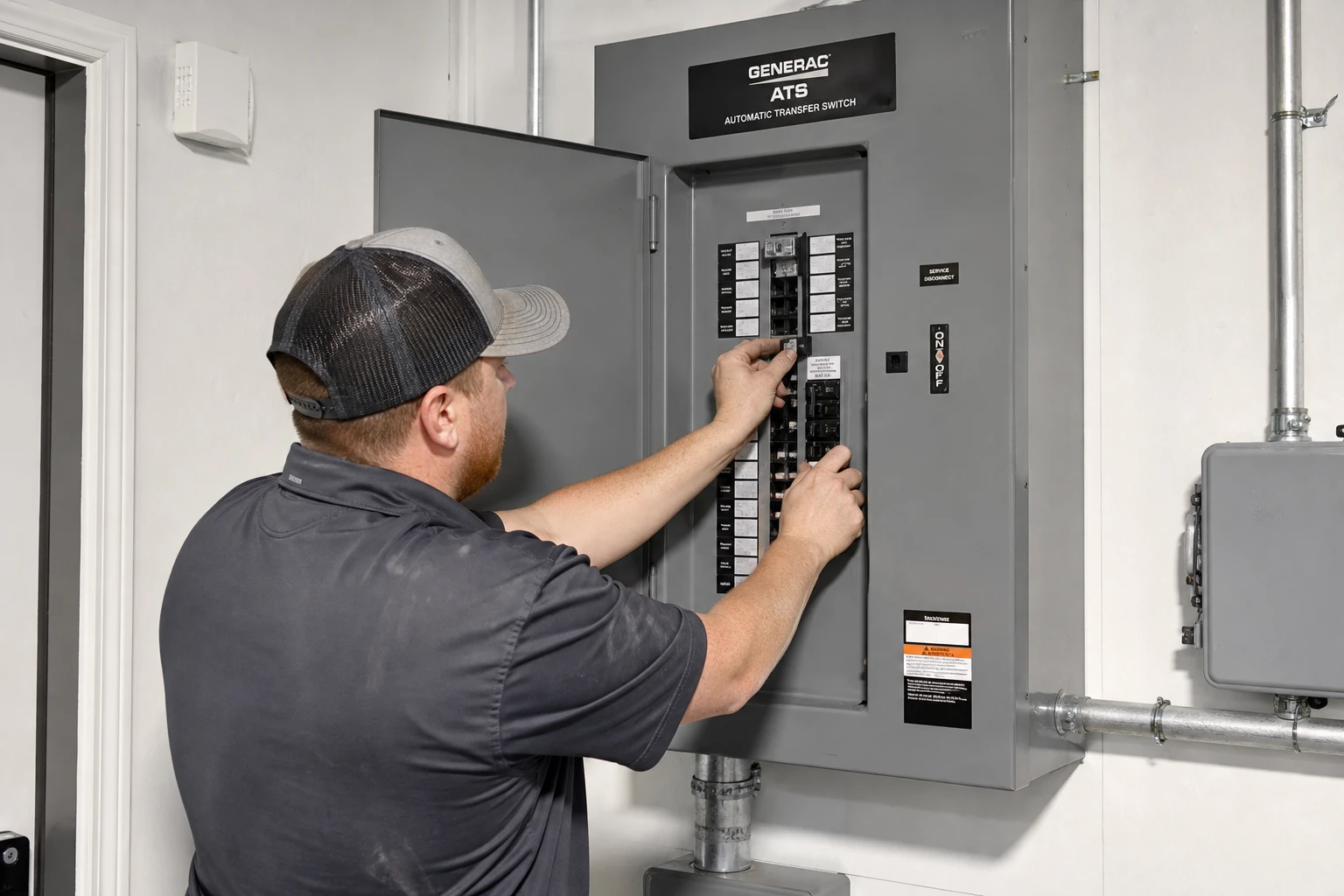
The transfer switch does one fundamental job: it disconnects your home from the utility grid before connecting the generator. Either you do this manually (manual transfer switch) or it happens automatically within seconds of a utility outage (automatic transfer switch, or ATS).
Manual vs. Automatic Transfer Switches
The choice between manual and automatic comes down to how quickly you need power restored and your budget for generator equipment:
Manual Transfer Switch: Less expensive, but requires someone to be home, start the generator, and manually throw the switch. Fine for occasional outages if someone is reliably home. Not appropriate for homes with medical equipment dependencies, smart home systems that need continuous power, or properties that may be unoccupied during a storm.
Automatic Transfer Switch (ATS): Monitors utility power continuously and activates the generator automatically, usually within 10–30 seconds of an outage. The generator starts, the ATS transfers the load, and you may barely notice the power went out. When utility power is restored, the ATS transfers back and shuts down the generator. For most custom homes, this is the preferred system.
Understanding Amperage: 200A, 400A, and 600A Systems
The amperage rating of your transfer switch must match the electrical service capacity of your home — and must be sized to handle the generator's output capacity. This is where many homeowners get confused.
200-Amp Systems
Standard residential service in North Carolina. A 200A transfer switch is appropriate for most single-family homes with standard electrical loads — central HVAC (up to about a 5-ton system), standard kitchen appliances, lighting, and electronics. Most residential standby generators producing 14–22kW can feed a 200A transfer switch.
400-Amp Systems
Required for larger homes, homes with multiple HVAC systems, or homes with significant additional loads (shop equipment, EV chargers, hot tubs, whole-house water heaters). Two 200A service entrances, or a single 400A service. Generator capacity of 30–48kW typically pairs with a 400A system.
600-Amp Systems
Custom homes with very large square footage, multiple HVAC systems, pools, EV charging infrastructure, and extensive lighting and appliance loads may require 600-amp service. These installations are more complex — a 600A service typically consists of three 200A panels or other configurations — and the transfer switch equipment must be sized to match. Generator capacity of 50–80kW+ is required for a full whole-home 600A backup. These installations require careful load analysis and coordination between the generator sizing, the transfer switch selection, and the utility service connection.
Critical Installation Requirements in North Carolina
Transfer switch installation in North Carolina must comply with the National Electrical Code (NEC) and must be permitted and inspected by the local Authority Having Jurisdiction (AHJ) — typically the county building inspections department. Key requirements include:
The transfer switch must be listed by UL or another NRTL for the intended application
Installation must be performed by a licensed electrical contractor
A permit must be pulled before work begins
The AHJ inspector must approve the installation before the generator is energized on the new connection
Utility notification may be required before connecting a standby generator system
Skipping the permit on a transfer switch installation is a mistake that has real consequences — both safety risks and insurance implications if an electrical fire or injury occurs on an unpermitted installation.
Generator Placement and Fuel Considerations
The transfer switch is only part of the system. The generator itself must be sited per NEC and manufacturer requirements:
Minimum clearances from windows, doors, and utility meters (typically 5 feet from openings, 1.5 feet from the house wall)
Pad-mounted on a concrete slab with proper drainage
Adequate clearance for service access
Most whole-home standby generators in North Carolina run on natural gas (if available) or propane. Natural gas provides effectively unlimited run time as long as service is available. Propane requires tank sizing for your anticipated outage duration — most residential installations use 500-gallon above-ground tanks, which provide several days of run time at average load.
Planning Generator Backup Power into a New Custom Home
The best time to install a whole-home generator system is during construction — before drywall, when electrical rough-in is accessible and the concrete slab for the generator pad can be coordinated with site work. Retrofitting a transfer switch and generator onto an existing home is absolutely doable, but it involves more disruption and coordination than integrating it from the start.
On new construction projects, we work with our electrical subcontractors to pre-wire for the transfer switch location, select generator pad placement that clears all setback requirements, and size the service entrance to accommodate the generator capacity the owner wants. If you're planning a custom home build and want generator backup capability, let's talk about building it in from day one.
Ready to start your project? Call South Eastern General Contractors at (910) 565-4719 or visit southeasterngc.com to schedule a consultation with our team.

South Eastern General Contractors
South Eastern General Contractors is a Native American-owned, 8(a) and HUBZone certified construction firm with over 21 years of proven results across Fayetteville, Lumberton, and the surrounding North Carolina communities. We build legacies, not just structures.
Ready to Build With Clarity and Confidence?
Your project deserves more than a contractor who just shows up and starts building. We guide you through a professional design-build process built around clear plans, detailed selections, documented scopes, and construction checklists that help eliminate confusion, mistakes, and missed expectations.
Other Blogs