Blog
Transfer Switch Sizing for Whole-Home Generators: What Your Electrician Needs to Tell You
Published
Category
Construction Guides
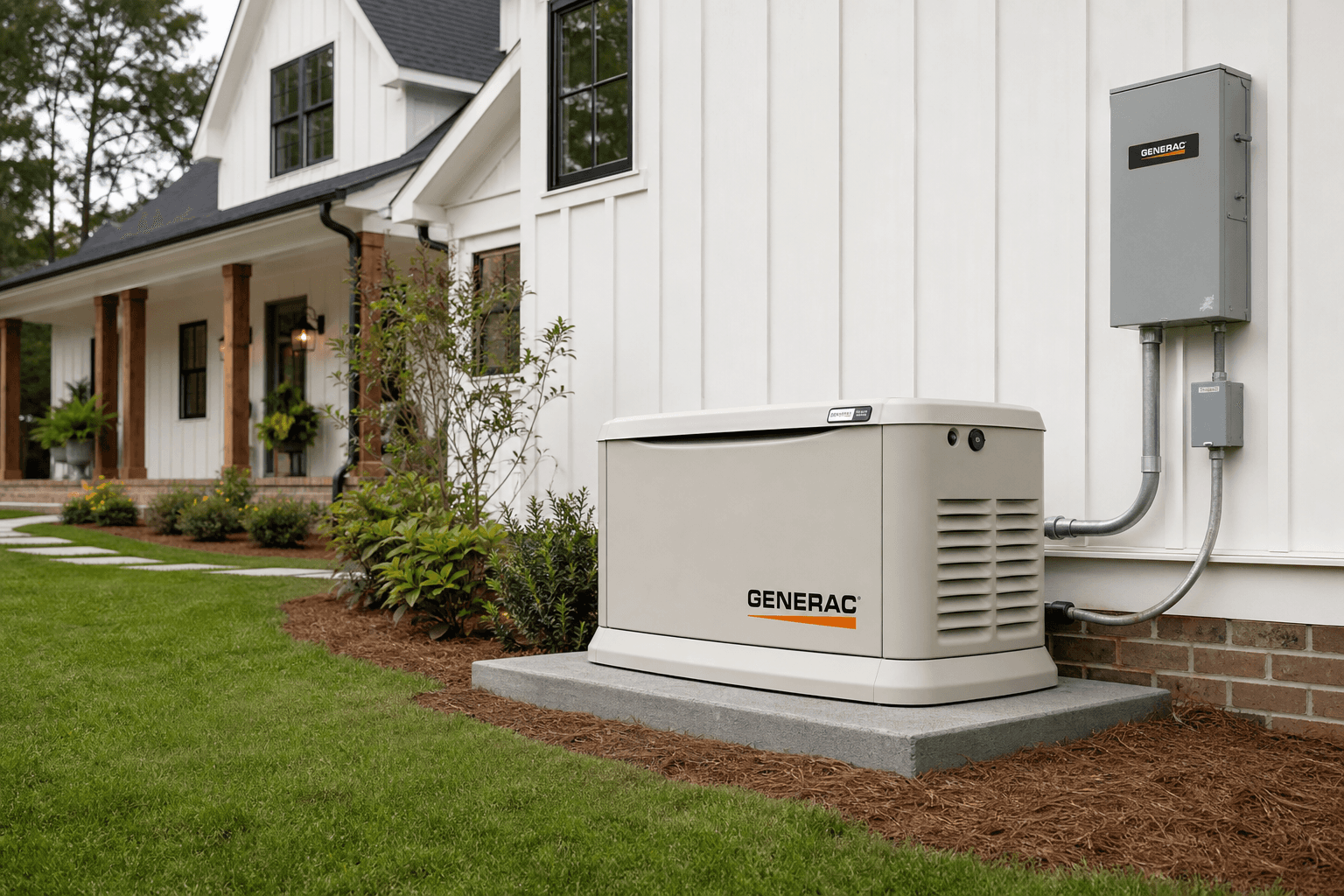
NC's storm seasons make whole-home generator prep a smart investment. But most homeowners don't know the transfer switch decision that determines whether your generator actually works when you need it.
In North Carolina, power outages aren't hypothetical. Between hurricane season remnants pushing up from the coast, ice storms in winter, and the isolated severe weather that hits the Fayetteville and Fort Bragg area throughout the year, being without power for 24–72 hours is a reality that many families face every few years.
A whole-home standby generator solves this problem — but only if it's correctly sized, properly connected, and fed by the right transfer switch. This is where a lot of homeowners get it wrong, and where getting it right during new construction is significantly cheaper than retrofitting it later.
What Is a Transfer Switch and Why Does It Matter?
When grid power fails, you cannot simply connect a generator directly to your home's electrical panel. Doing so would energize the utility lines, creating a serious electrocution hazard for utility workers trying to restore power — and it's illegal.
A transfer switch safely disconnects your home from the utility grid and connects it to your generator as a separate power source. There are two main types:
Manual Transfer Switch
A manual transfer switch requires you to physically flip a lever or switch to transfer from utility to generator power. You also have to manually start the generator. These are simpler and less expensive, but they require you to be home and physically capable of making the switch — not ideal in a severe storm at 2 AM.
Automatic Transfer Switch (ATS)
An automatic transfer switch detects a utility outage and automatically starts the generator and transfers the load — typically within 10–30 seconds. When utility power is restored, it switches back and shuts down the generator. For whole-home standby generators (permanently installed, gas or propane-fueled), an ATS is standard.
Sizing the Transfer Switch
Transfer switch sizing must match or exceed your generator's output capacity AND accommodate your home's electrical service. Here's how to think about it:
Match Your Service Size
Standard new construction in NC: 200-amp main service
Larger custom homes with EVs, pools, or workshops: 400-amp service becoming more common
Your transfer switch must match your service amperage — a 200A service needs a 200A transfer switch
Match Your Generator Output
A 22kW generator typically needs a 100–200A transfer switch depending on configuration
Don't oversize the generator relative to your transfer switch capacity
With a whole-home ATS, the transfer switch handles the full panel; the generator sizing determines what you can actually run simultaneously
Whole-Home Generator Sizing: What Do You Actually Need?
This is where many homeowners make the mistake of undersizing. A portable 7,500-watt generator can run some appliances. A properly sized whole-home standby generator runs everything.
For reference, typical whole-home loads:
Central HVAC (3-ton): 3,500–5,000 watts running, 10,000+ startup surge
Electric water heater: 4,500 watts
Refrigerator: 150–800 watts
Lighting (whole home): 500–2,000 watts
Well pump: 750–2,000 watts
Security system, garage doors, appliances: additional load
For most 2,000–3,500 sq ft custom homes, a 22kW standby generator handles the full home load comfortably, including running central air. For larger homes or those with two HVAC zones, 26kW–36kW is more appropriate.
Why Generator Prep During New Construction Is Smart
If you know you want a whole-home generator — or even if you just want to be generator-ready — adding generator prep during construction costs a fraction of a retrofit:
Generator pad: A poured concrete generator pad costs $300–$600 during construction vs. $1,000–$2,000 after landscaping is in
Transfer switch installation: Much simpler when the panel is being installed, not after walls are closed
Natural gas or propane line stub-out: Running a gas line to the generator pad during construction costs $200–$500; after the home is finished it can cost $1,000–$3,000+
Conduit run: Electrical conduit from panel to pad can be embedded in the foundation or slab during construction
Total generator prep cost during a new build: typically $1,500–$3,500 depending on scope. Total cost to retrofit a finished home: often $5,000–$10,000+ before you even buy the generator itself.
Our Recommendation for New Construction in NC
At minimum, add generator prep — pad, conduit stub-out, gas line stub-out, and transfer switch rough-in — during your build. This costs relatively little and gives you the option to add the generator whenever you're ready without tearing up landscaping or paying for extensive retrofit work.
If you're building in an area prone to extended outages, or if the home has critical medical equipment, a sump pump, or other systems that can't afford downtime — spec the full standby generator during construction.
Questions About Generator Prep on Your Custom Build?
South Eastern General Contractors coordinates generator prep as part of our custom home electrical planning. We work with licensed electrical subcontractors who know exactly what's needed for proper whole-home generator installation — whether you add the unit during construction or later.
Call us at or visit southeasterngc.com.

South Eastern General Contractors
South Eastern General Contractors is a Native American-owned, 8(a) and HUBZone certified construction firm with over 21 years of proven results across Fayetteville, Lumberton, and the surrounding North Carolina communities. We build legacies, not just structures.
Ready to Build With Clarity and Confidence?
Your project deserves more than a contractor who just shows up and starts building. We guide you through a professional design-build process built around clear plans, detailed selections, documented scopes, and construction checklists that help eliminate confusion, mistakes, and missed expectations.
Other Blogs