Blog
Septic System Permits and Installation in North Carolina: What Homeowners Need to Know
Published
Category
Planning & Budget
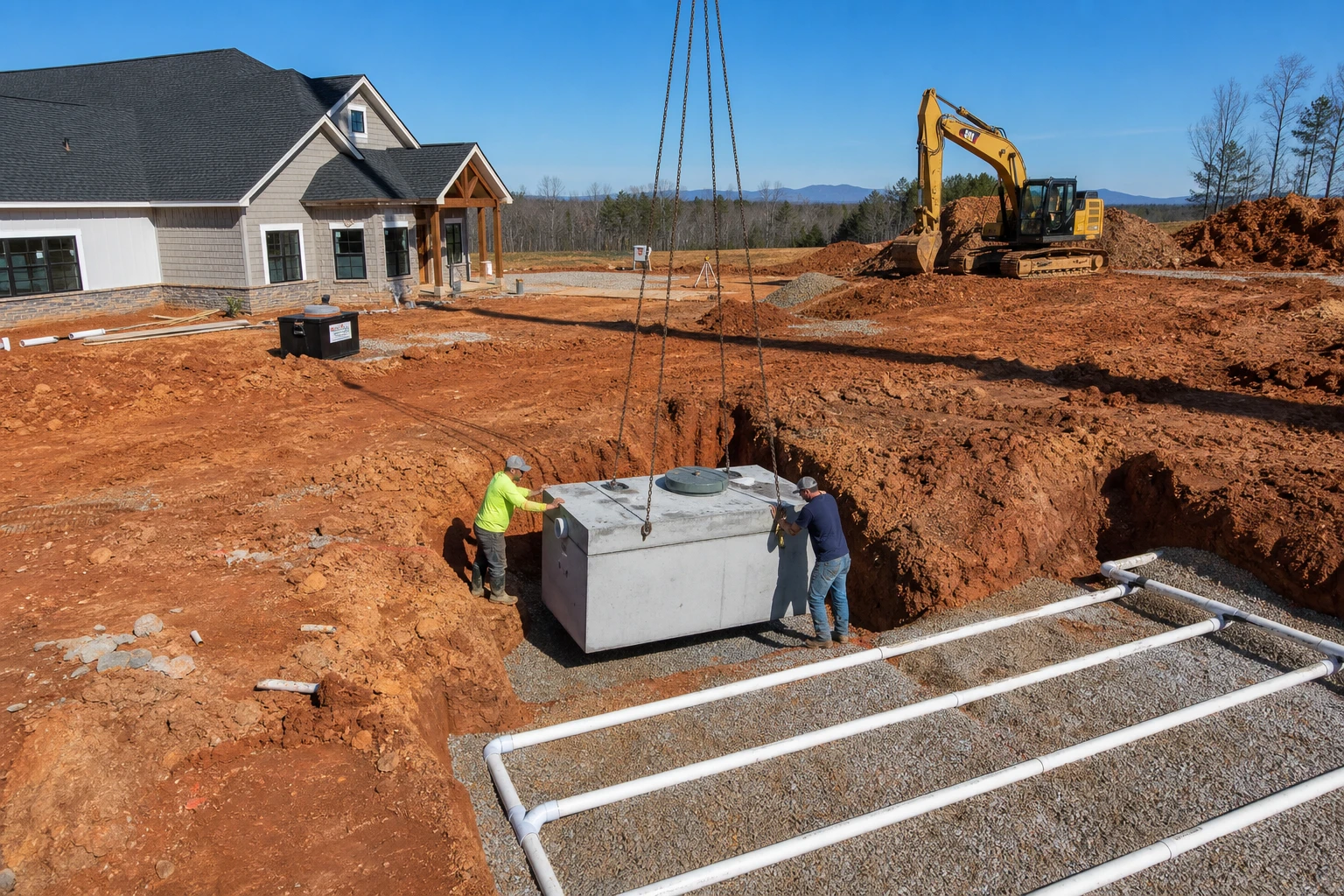
Building outside city sewer service in NC? Here's a complete guide to septic system permits, installation timelines, and common delays that can hold up your construction schedule.
Building a custom home outside the reach of municipal sewer service in North Carolina means one major infrastructure decision: your septic system. It's one of the most regulated, site-specific, and timeline-sensitive components of any new home build — and the permit and inspection process can surprise homeowners who aren't prepared for it. After years of building custom homes across Cumberland, Robeson, and Hoke counties, we've navigated every scenario the North Carolina permitting process throws at you. Here's what you need to know before you break ground.
Who Regulates Septic Systems in North Carolina?
In North Carolina, septic system permits are issued and inspected at the county level by the local Environmental Health department. Each county has its own staff and can have slightly different procedural requirements, though all must follow the state's rules under 15A NCAC 18A .1900 — the Sewage Treatment and Disposal Rules. Cumberland County, Robeson County, and Hoke County each have their own Environmental Health offices that handle permits for properties in their jurisdictions.
Step 1: Soil Evaluation (Site Suitability)
Before any permit can be issued, a certified soil scientist must evaluate your site to determine whether it can support a septic system and what type. This evaluation, sometimes called a "site suitability evaluation" or "perc test" (though modern NC evaluations go far beyond a simple percolation test), looks at:
Soil texture and structure at multiple depths
Depth to restrictive horizons (clay layers, rock, water table)
Seasonal high water table evidence
Available drain field area and setback requirements
Topography and lot size relative to drain field needs
The soil evaluation determines not only whether a septic system is feasible, but what type is required — conventional gravity system, pump system, drip irrigation system, or in challenging soils, a more engineered solution. Budget 2–6 weeks for this evaluation plus the county review to issue an Authorization to Construct (ATC).
Step 2: Septic Permit and System Design
Once the soil evaluation determines suitability, the county issues an Authorization to Construct. This document specifies:
The approved system type and configuration
Required tank size (based on bedroom count)
Drain field layout, dimensions, and setbacks
Any pump, timer, or distribution box requirements
The Authorization to Construct is property-specific. It stays with the land and must be kept on file through the entire project. Don't lose it — you'll need it at final inspection and it's the document that proves the system was permitted.
Step 3: Installation by a Licensed Contractor
In North Carolina, septic system installation must be performed by a licensed Soil Scientist or Onsite Wastewater Contractor. Your general contractor will coordinate this, but the septic sub must be independently licensed for this work. Installation typically involves:
Excavation and placement of the septic tank (typically concrete or polyethylene)
Installation of the distribution box and drain field lines
Gravel or chamber media in the drain field
If a pump system: installation of the pump vault, pump, float switches, and control panel
Proper grading and backfill
Timing matters: most county health departments need advance notice before the system is covered — typically 24–48 hours — so the inspector can see the installed system before backfill.
Step 4: County Inspection
The county Environmental Health inspector must inspect the installed system before it can be covered. This inspection verifies that installation matches the approved design. If anything doesn't match — pipe depths, tank placement, drain field dimensions — it must be corrected and re-inspected before you can proceed.
Step 5: The Permit That Often Gets Overlooked — Electrical Connection
This is the step that surprises many homeowners and even some contractors: if your septic system includes a pump station, the county will not issue the final septic operating permit until electrical power is connected to the pump station. This creates a sequencing dependency in your construction schedule that must be planned for in advance.
The logic makes sense — the inspector needs to confirm the pump and floats operate correctly before the system can be certified for use. But if your electrical rough-in isn't ready or temporary power hasn't been established, your septic permit can be held up even after the physical installation is complete. We track this dependency carefully on every project to avoid last-minute surprises.
Common Delays and How to Avoid Them
After managing dozens of septic permitting processes in the Fayetteville area, these are the delays we plan around:
Scheduling the soil evaluation early: County soil scientists have full calendars. Request the evaluation before you even finalize your house plan — soil findings can affect foundation type, grading, and lot coverage calculations.
Jurisdictional variance: Robeson County, Cumberland County, and Hoke County can have meaningfully different review timelines. Plan for 4–8 weeks from evaluation to Authorization to Construct in busy periods.
Alternative system designs: If your soil evaluation requires an engineered system (pressure distribution, drip, etc.), add time for additional plan review.
Power sequencing: As noted above — confirm your septic contractor and electrician are coordinating the power connection timeline so the operating permit isn't the last thing blocking your certificate of occupancy.
How Long Does the Whole Process Take?
For a typical conventional septic system in Cumberland, Robeson, or Hoke County, the full sequence — from soil evaluation through final operating permit — takes 8 to 16 weeks under normal conditions. More complex systems or challenging soils can extend this. This is why septic permitting should be one of the first things initiated on a custom home project, not something addressed after permits for the house structure are in hand.
Planning Your Build Around Septic Timing
At South Eastern General Contractors, septic system permitting is one of the first parallel tracks we open on any rural or semi-rural custom home project. We initiate the soil evaluation, line up our licensed septic contractor, and build the inspection milestone into the project schedule — including the electrical sequencing dependency — so there are no surprises late in the build.
If you're planning a custom home in the Fayetteville area and wondering whether your site is suitable for a conventional septic system, we can help you start the evaluation process before you've even finalized your floor plan.
Ready to start your project? Call South Eastern General Contractors at (910) 565-4719 or visit southeasterngc.com to schedule a consultation with our team.

South Eastern General Contractors
South Eastern General Contractors is a Native American-owned, 8(a) and HUBZone certified construction firm with over 21 years of proven results across Fayetteville, Lumberton, and the surrounding North Carolina communities. We build legacies, not just structures.
Ready to Build With Clarity and Confidence?
Your project deserves more than a contractor who just shows up and starts building. We guide you through a professional design-build process built around clear plans, detailed selections, documented scopes, and construction checklists that help eliminate confusion, mistakes, and missed expectations.
Other Blogs