Blog
How Long Does It Take to Build a Custom Home in NC? (Updated 2026)
Published
Category
Planning & Budget
Updated for 2026 market conditions: here's the realistic custom home construction timeline in North Carolina, what causes delays, and how to set expectations with your builder.
The Honest Answer: 10-14 Months for Most Custom Homes in 2026
If you search "how long does it take to build a custom home," you'll find answers ranging from 6 months to 24 months. That wide range exists because the answer depends on dozens of variables — home size, complexity, site conditions, weather, permit timelines, material availability, and builder workload. But for a well-managed custom home project in the Fayetteville, NC area in 2026, here's the realistic range:
Simple custom home (1,800-2,500 sq ft, single story, standard finishes): 8-10 months from permit to Certificate of Occupancy
Mid-complexity custom (2,500-3,500 sq ft, two story, upgraded finishes): 10-12 months
High-complexity custom (3,500+ sq ft, multi-level, high-end finishes, complex site): 12-16 months
These timelines assume the lot is purchased, plans are finalized, and permitting is underway before the clock starts. The pre-construction phase (design, engineering, permitting) adds 2-4 months before the first shovel hits the dirt.
At South Eastern General Contractors, we've been building custom homes in the Fayetteville and Fort Bragg area for over 21 years. We've refined our construction timeline through hundreds of projects, and we've learned what accelerates builds and what derails them. Here's a phase-by-phase breakdown of what to expect.
Phase 1: Pre-Construction (2-4 Months Before Groundbreaking)
This phase happens before any construction begins and is entirely about preparation. Most homeowners underestimate how long pre-construction takes — and rushing it creates problems that compound throughout the build.
Design and Engineering (4-8 weeks)
Working with an architect or home designer to finalize floor plans, elevations, and structural details. This includes:
Floor plan design with all room dimensions, window/door placement, and structural elements
Exterior elevations showing siding, roofing, trim, and window styles
Structural engineering (truss design, foundation design, beam calculations)
Site plan showing the home's position on the lot, driveway, utilities, and grading
Permitting (2-6 weeks)
Cumberland County and the City of Fayetteville both have building permit processes with different timelines:
City of Fayetteville: Plan review typically takes 2-4 weeks for residential. The plan review department checks structural, mechanical, plumbing, and electrical compliance with the NC Residential Code.
Cumberland County (unincorporated areas): Generally faster — 1-3 weeks for straightforward residential plans.
Hoke County: Similar to Cumberland County timelines.
Septic permit (if applicable): If the lot is not on municipal sewer, a septic system permit from the county health department is required before the building permit is issued. Septic permitting includes a soil evaluation (perk test) and system design, which can take 2-4 weeks depending on the county's schedule.
Material Selections (Ongoing, but critical decisions by permit time)
Major material selections — siding, roofing, windows, cabinets, flooring, countertops — should ideally be made during pre-construction so that lead times can be factored into the schedule. In 2026, most materials are readily available (the COVID-era supply chain disruptions have largely resolved), but some items still have lead times:
Custom windows (Marvin, Andersen custom): 6-10 weeks
Custom cabinets: 6-10 weeks
Specialty stone/countertops: 3-6 weeks for fabrication
Standard materials (lumber, drywall, roofing): 1-2 weeks, readily available
Phase 2: Site Work and Foundation (3-5 Weeks)
Once the building permit is issued, construction begins with site preparation:
Week 1: Clearing, grubbing, and rough grading of the building pad. If trees need to be removed or the lot needs significant grade work, this can take longer.
Week 2: Utility connections (temporary power, water tap, sewer/septic connection), footing layout, and excavation. Under-slab plumbing rough-in.
Week 3: Foundation pour (monolithic slab or stem wall footings). Foundation cure time — typically 7 days minimum before framing begins, though the slab continues to cure for 28 days.
Weeks 4-5: Waterproofing, backfill (if stem wall), and final grading around the foundation. Foundation inspection.
Weather is the biggest variable in this phase. In Fayetteville's climate, heavy rain events can delay excavation, grading, and concrete pours by days or weeks. Spring (March-May) and fall (September-November) are the most reliable seasons for foundation work. Summer thunderstorms and winter cold snaps (rare but possible) can cause schedule disruptions.
Phase 3: Framing (4-6 Weeks)
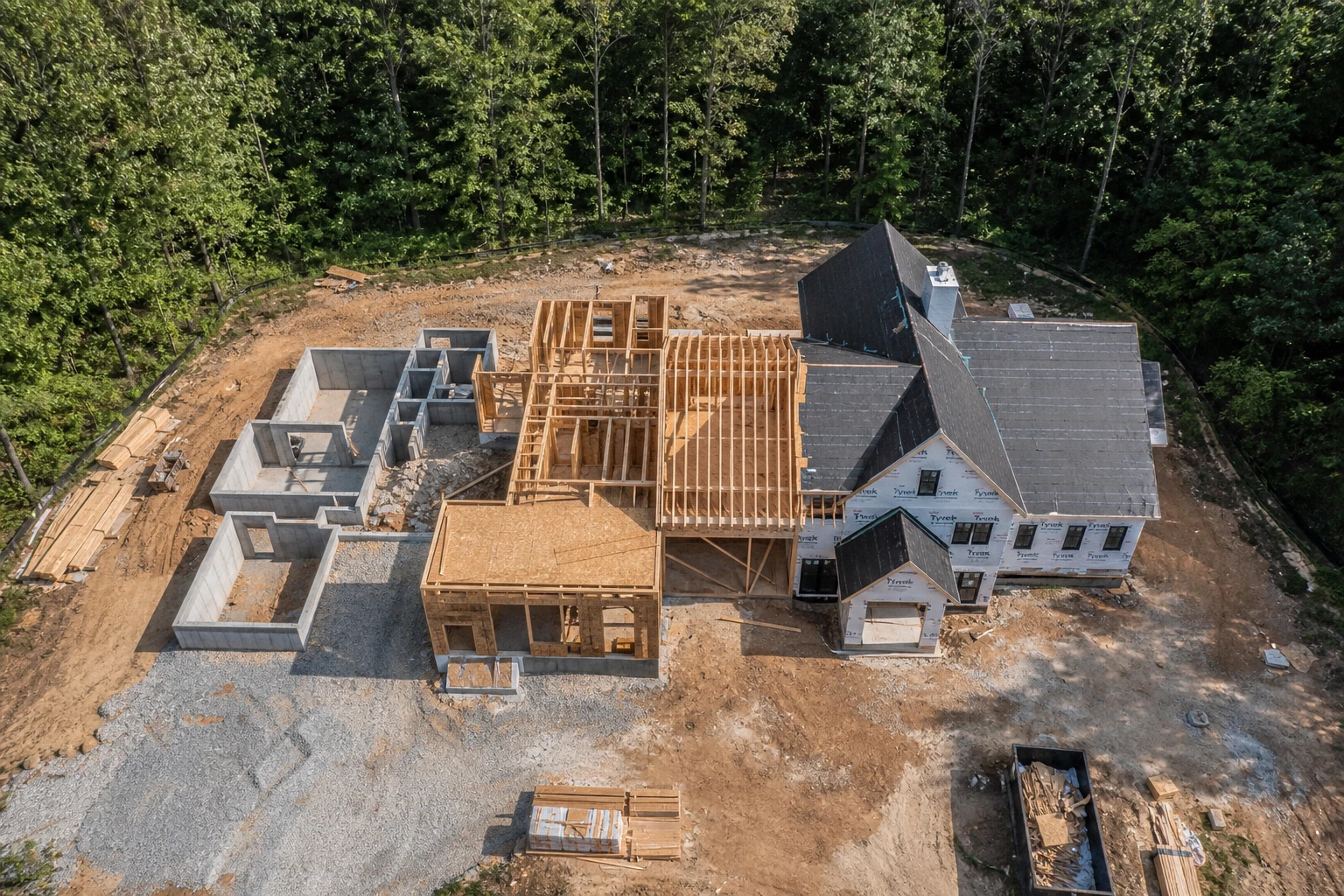
Framing is the most visually dramatic phase — your home goes from a flat slab to a three-dimensional structure in a matter of weeks.
Weeks 1-2: Wall framing — exterior walls, interior partitions, and structural elements. A good framing crew can stand the walls on a single-story home in 3-5 days.
Week 3: Second floor framing (if applicable), stair framing, and roof truss/rafter installation.
Week 4: Roof sheathing, exterior wall sheathing (ZIP System or plywood/OSB with house wrap), and window/door installation.
Week 5-6: Porch framing, garage framing, exterior trim details, and framing punch-out (corrections, blocking, backing). Framing inspection.
Phase 4: Mechanical Rough-Ins (3-4 Weeks)
After the framing inspection passes, the mechanical trades move in simultaneously:
Plumbing rough-in: Supply lines, drain lines, vent stacks, and fixture connections roughed in within the wall and floor cavities. Pressure test.
HVAC rough-in: Ductwork installation, air handler placement, refrigerant lines, and exhaust fan ducting.
Electrical rough-in: All wiring, outlet boxes, switch boxes, panel installation, low-voltage wiring (network, security, audio), and smoke/CO detector wiring.
Each trade gets its own inspection. All three rough-in inspections must pass before insulation and drywall can proceed.
Phase 5: Insulation, Drywall, and Interior Finishes (6-10 Weeks)
This is the longest phase and where most of the visible transformation happens:
Weeks 1-2: Insulation installation (spray foam, blown-in, or batt depending on spec), insulation inspection, and blower door test.
Weeks 2-4: Drywall hanging, mudding, taping, and sanding. On SEGC homes, we apply a Level 5 finish — a skim coat over the entire surface for the smoothest possible result. This adds time but eliminates visible seams and fastener marks.
Week 4-5: Priming and painting.
Weeks 5-8: Cabinet installation, countertop fabrication and installation, flooring installation, tile installation, trim carpentry (baseboards, crown molding, door casings, window casings).
Weeks 8-10: Plumbing fixtures (faucets, toilets, shower heads), electrical fixtures (lights, switches, outlets), HVAC equipment startup and testing, appliance installation.
Phase 6: Exterior Finishes (Concurrent with Interior, 4-8 Weeks)
While interior work progresses, exterior finishes happen in parallel:
Siding installation (HardiePlank, brick veneer, stone, metal, board and batten)
Roofing (if not completed during framing phase)
Exterior painting and caulking
Gutters and downspouts
Driveway and walkway concrete or pavers
Grading, drainage, and landscaping
Deck or porch finishing
Phase 7: Final Inspections and Closeout (2-3 Weeks)
Final building inspection (all systems complete and functional)
Final electrical, plumbing, and mechanical inspections
Fire marshal inspection (if applicable)
Certificate of Occupancy issued
Builder walkthrough with homeowner — punch list creation
Punch list completion
Closing and key handover
What Causes Delays (and How to Avoid Them)
Weather — unavoidable, but a good builder builds weather contingency into the schedule. Expect 2-3 weeks of weather delays on a 12-month build in NC.
Late material selections — if you haven't chosen cabinets by the time framing is complete, the cabinet lead time pushes the interior finish schedule back. Make selections early.
Change orders during construction — moving a wall, adding a window, or changing the kitchen layout mid-build requires re-engineering, re-permitting, and rework. Changes are expensive in time and money. Lock your plans before permitting.
Subcontractor scheduling — a builder is only as reliable as their subcontractor relationships. Builders with established, loyal sub crews get priority scheduling. New or unknown builders wait in line.
Inspection delays — during busy building seasons, inspectors can be booked 3-5 days out. A failed inspection adds the correction time plus the re-inspection wait. This is why SEGC's pre-inspection walkthrough is so valuable — passing the first time keeps the schedule moving.
Build on SEGC's Timeline, Not a Production Builder's Promise
Production builders advertise "4-6 month build times" because they're building repetitive floor plans with standardized methods and pre-ordered materials. A custom home takes longer because it's custom — every element is designed for you, every detail is intentional, and the quality of construction reflects the time invested.
At South Eastern General Contractors, we provide a detailed construction schedule at contract signing and update it throughout the build. Our homeowners know what's happening, when it's happening, and why. With over 21 years of custom home building in Fayetteville and the surrounding NC communities, and as a Native American-owned, 8(a) and HUBZone certified firm, we've earned the trust of over 120 five-star Google reviewers by delivering what we promise — on quality and on timeline.
Ready to start planning your custom home? Contact SEGC at (910) 565-4719 or visit southeasterngc.com to schedule a consultation.

South Eastern General Contractors
South Eastern General Contractors is a Native American-owned, 8(a) and HUBZone certified construction firm with over 21 years of proven results across Fayetteville, Lumberton, and the surrounding North Carolina communities. We build legacies, not just structures.
Ready to Build With Clarity and Confidence?
Your project deserves more than a contractor who just shows up and starts building. We guide you through a professional design-build process built around clear plans, detailed selections, documented scopes, and construction checklists that help eliminate confusion, mistakes, and missed expectations.
Other Blogs