Blog
What Happens During a Framing Inspection in NC? A Homeowner's Guide
Published
Category
Construction Guides
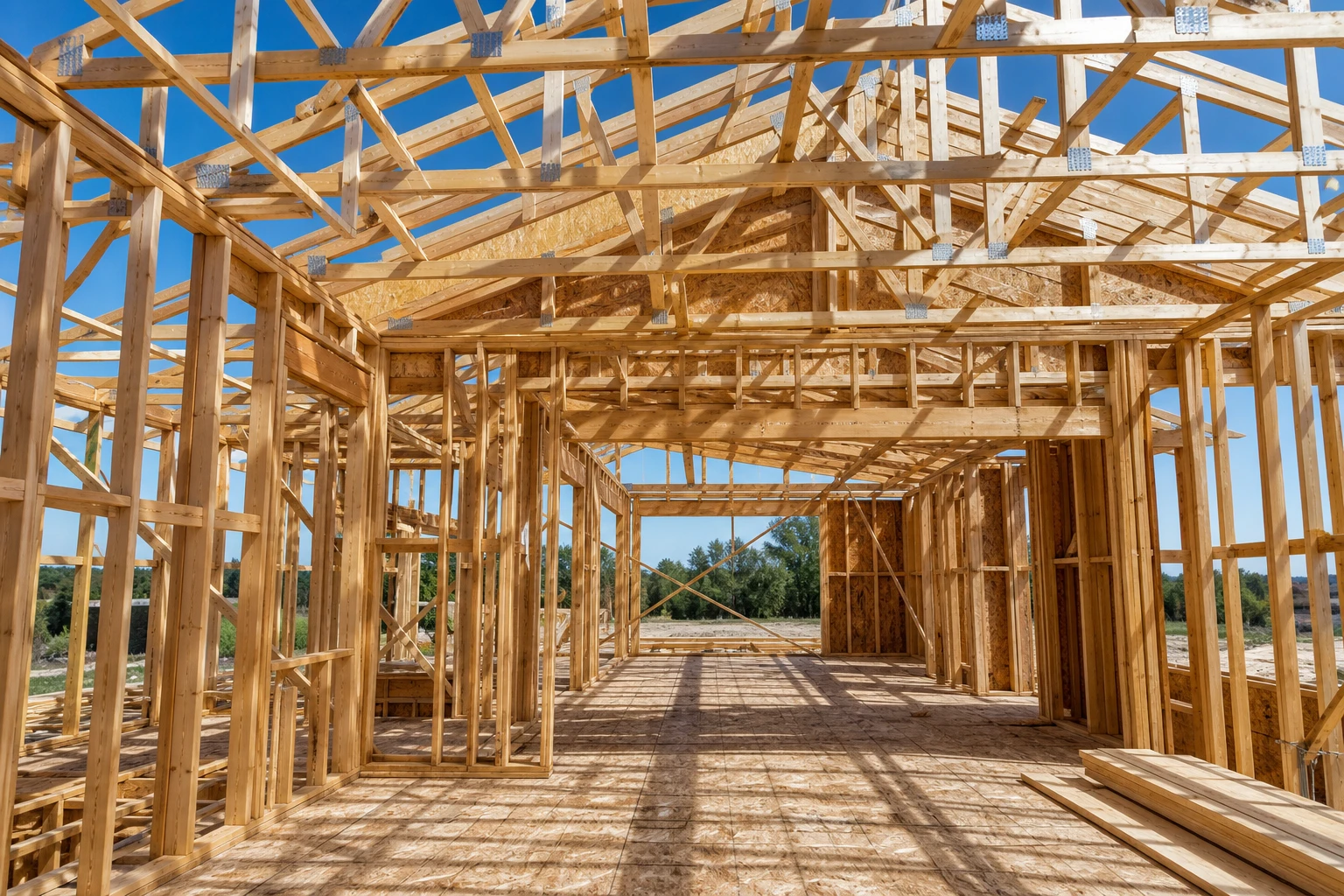
The framing inspection is one of the most important milestones in new home construction. Here's what NC inspectors check, what causes failures, and what you should know as the homeowner.
The Framing Inspection: Where Your Home's Skeleton Gets Its Report Card
If the foundation is the backbone of your home, the framing is the entire skeletal system. Walls, floors, roof, and every structural connection between them — it all comes together during the framing phase. And before a single sheet of drywall can go up, a North Carolina building inspector needs to walk through and verify that every stud, joist, header, and connection meets the structural requirements of the NC Residential Code.
The framing inspection is one of the most consequential inspections in the entire build process. If the foundation inspection checks whether the bones are in the right place, the framing inspection checks whether they're strong enough to carry the load. At South Eastern General Contractors, we've been through this inspection on hundreds of custom homes across the Fayetteville and Fort Bragg area. Here's what the inspector looks for, what causes failures, and what homeowners should understand about the process.
When Does the Framing Inspection Happen?
The framing inspection is called after:
All structural framing is complete (walls, floors, roof structure, stairs)
Roof sheathing is installed
Exterior sheathing (ZIP System, plywood, or OSB) is installed
Windows and exterior doors are installed in their rough openings
Fireplace framing and chimney chases are complete
But before:
Any insulation is installed
Any drywall is hung
Mechanical rough-ins (HVAC, plumbing, electrical) — though in practice, these often happen concurrently with the final framing punch-out
The timing matters because the inspector needs to see every structural connection, every header, every tie-down, and every piece of blocking without anything covering it up. Once insulation and drywall go in, these elements are hidden for the life of the building.
What the Inspector Checks
Wall Framing
Stud spacing — 16" on center is standard for load-bearing walls in NC residential construction. Some plans specify 24" OC for interior non-bearing partitions. The inspector verifies spacing matches the approved plans.
Double top plates — load-bearing walls require double top plates with joints staggered by at least 48". This distributes the roof and upper floor loads across the wall system.
Headers over openings — every window, door, and other opening in a load-bearing wall needs a structural header sized for the span. A 4' opening might use a 2x8 or 2x10 header; a 6' opening might require a 2x12 or an engineered LVL beam. The inspector checks that header sizes match the structural plans and that they're properly supported by jack studs (trimmers) on each side.
Cripple studs — short studs above headers and below window sills that maintain the stud spacing pattern. Missing or improperly spaced cripples are a common fail.
Corner framing — exterior corners need adequate nailing surface for both the exterior and interior finishes, plus structural connections that transfer loads properly through the corner.
Floor Framing
Joist sizing and spacing — floor joists must match the approved plans in size, species, grade, and spacing. A floor designed for 2x10 joists at 16" OC can't be built with 2x8s or 2x10s at 24" OC.
Bearing points — joists need to bear on the wall below by at least 1.5" (the width of the bottom plate). Joists hanging off the edge of a wall are a critical structural failure.
Blocking and bridging — solid blocking or cross-bridging is required at bearing points and typically at mid-span for joists over 12 feet. This prevents the joists from rolling under load.
Cantilevers — if the floor system extends beyond the foundation wall (common for bay windows and bump-outs), the cantilever must not exceed the allowable span and needs proper insulation blocking at the wall line.
Roof Framing
Rafter or truss spacing and sizing — same principle as floor joists. The inspector checks that rafters or trusses match the engineered plans in spacing, size, and connection details.
Ridge beam vs. ridge board — a structural ridge beam (which carries load) is different from a ridge board (which is just a nailing surface). If the plans call for a ridge beam, the inspector verifies it's the correct size and properly supported by posts at each end.
Collar ties and rafter ties — these horizontal members connect opposing rafters and prevent the walls from spreading under roof load. The code specifies where they go and how they're attached.
Hurricane ties — metal connectors (Simpson Strong-Tie H2.5 or similar) that connect each rafter or truss to the top plate of the wall below. In eastern NC, hurricane ties are code-required and the inspector will check every single one. Missing a hurricane tie on one rafter can fail the entire inspection.
Sheathing
Wall sheathing — the exterior sheathing (OSB, plywood, or ZIP System panels) must be properly fastened per the nailing schedule — typically 8d nails at 6" OC on edges and 12" OC in the field. Under-nailing sheathing reduces the wall's shear resistance (its ability to resist lateral wind loads). The inspector will spot-check nailing patterns across multiple wall sections.
Roof sheathing — same nailing schedule applies. Additionally, panel edges need to land on framing members, and H-clips or tongue-and-groove edges are required between supports if the span exceeds the panel rating.
Hold-Downs and Shear Wall Connections
In NC's wind zones, the inspector pays close attention to the continuous load path — the chain of connections that transfers wind and gravity loads from the roof through the walls and into the foundation. This includes:
Hold-down hardware — metal straps or bolts that anchor shear wall end studs to the foundation. These resist uplift forces from wind.
Anchor bolts — embedded in the foundation, connecting the bottom plate of the wall to the concrete. The inspector checks spacing (typically every 6 feet, within 12" of plate ends) and that washers and nuts are properly installed.
Strap connections — metal straps that connect upper and lower wall framing at multi-story transitions.
The Most Common Fail Reasons
Based on our experience across Cumberland County and surrounding jurisdictions:
Missing hurricane ties — the #1 fail. Every rafter or truss needs one, and it's easy to miss one or two in a complex roof system.
Undersized headers — especially when field changes are made (widening an opening, for example) without updating the structural plan.
Sheathing nailing deficiencies — nails too far from panel edges, nails that missed the framing, or insufficient nail count per code requirements.
Missing or misplaced blocking — at bearing points, stair openings, and plumbing wall reinforcement locations.
Plan deviations without engineering approval — any change from the approved plans (moved walls, relocated openings, different lumber sizes) needs a revised plan or an engineer's field approval letter. Building it differently and hoping the inspector won't notice doesn't work.
What Homeowners Should Know
As the homeowner, the framing inspection is one of the best times to visit your build site. The framing is the most visual and tangible milestone — for the first time, you can walk through your home and see the room sizes, ceiling heights, and spatial relationships in three dimensions. A few things to keep in mind:
The inspector works for the jurisdiction, not the builder. Their job is code compliance, period. A passed framing inspection means the structure meets the minimum code requirements. It doesn't mean the framing is perfect or that every detail matches your expectations.
Your builder's quality control should exceed the inspector's checklist. A good builder doesn't rely on the inspector to catch problems — they have their own pre-inspection process that catches issues before the inspector arrives.
Don't panic about correction notices. Even the best framers occasionally miss a hurricane tie or need to add a nail plate. A correction notice means the inspector found something that needs to be fixed before they'll approve the inspection. It's normal and doesn't mean the house is in trouble.
SEGC's Approach to Framing Quality
At South Eastern General Contractors, our project superintendent walks every framing job before we call for inspection. We check hurricane tie installation, verify header sizes against the plans, spot-check sheathing nailing, and confirm all hold-down hardware is properly installed. This pre-inspection adds time to our process, but it means we pass the framing inspection the first time, virtually every time.
With 21+ years of custom home building in the Fayetteville and Fort Bragg area, and as a Native American-owned, 8(a) and HUBZone certified firm, SEGC brings accountability and attention to detail that production builders simply don't match.
Ready to build a custom home with a builder who sweats the details? Contact SEGC at (910) 565-4719 or visit southeasterngc.com.

South Eastern General Contractors
South Eastern General Contractors is a Native American-owned, 8(a) and HUBZone certified construction firm with over 21 years of proven results across Fayetteville, Lumberton, and the surrounding North Carolina communities. We build legacies, not just structures.
Ready to Build With Clarity and Confidence?
Your project deserves more than a contractor who just shows up and starts building. We guide you through a professional design-build process built around clear plans, detailed selections, documented scopes, and construction checklists that help eliminate confusion, mistakes, and missed expectations.
Other Blogs