Blog
The Drywall Installation Process in New Home Construction: A Complete Walkthrough
Published
Category
Construction Guides
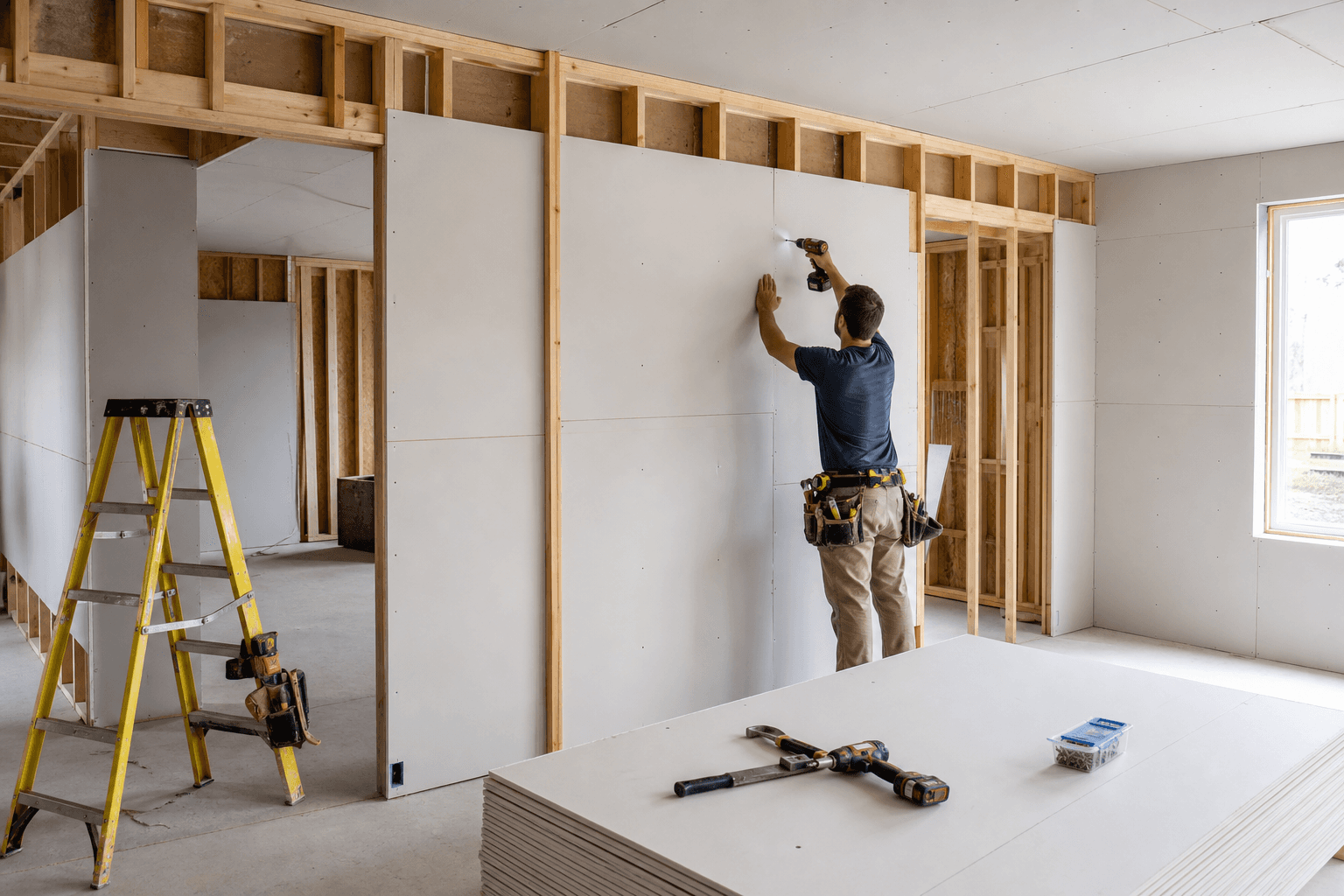
What happens during the drywall phase of new home construction? From material delivery and hanging to taping, mudding, and sanding — here's every step explained by a veteran builder.
Drywall is the phase that transforms a framed skeleton into a home that actually looks like a home. It is also one of the most misunderstood stages of construction — homeowners see the walls go up quickly and assume the house is nearly done, when in reality the drywall phase involves multiple steps spread over two to three weeks, and finishing work still has months to go.
At South Eastern General Contractors, we manage the drywall phase on every custom home we build in Fayetteville and across North Carolina. This guide walks you through every step of the process so you know exactly what to expect when your new home reaches this milestone.
Before Drywall: What Has to Be Complete First
Drywall cannot begin until several critical phases are finished and inspected:
Framing inspection passed — The county inspector has verified structural framing, nailing patterns, shear walls, and load paths.
Electrical rough-in complete and inspected — All wiring, boxes, and panel connections are installed and approved.
Plumbing rough-in complete and inspected — Supply lines, drains, and vents are in place and pressure-tested.
HVAC rough-in complete and inspected — Ductwork is installed, sealed, and tested for leakage compliance.
Insulation installed and inspected — Wall insulation (fiberglass batts, blown-in, or spray foam) is in place, and the insulation inspection is passed.
Low-voltage wiring complete — Networking cables, speaker wire, security system wiring, and any other low-voltage runs are in the walls before they get covered.
This sequencing is critical. Once drywall goes up, accessing anything behind the walls requires cutting into finished surfaces. Every trade and every inspection must be complete before the first sheet is hung.
Step 1: Material Delivery and Staging
Drywall material delivery is a planned event, not a casual drop-off. For a typical 2,500-square-foot home, expect approximately 200 to 300 sheets of drywall weighing over 10,000 pounds total.
The delivery truck uses a boom to place stacks of drywall directly inside the house through window openings or the garage. Sheets are distributed throughout the home — stacked in the rooms where they will be used — to minimize handling during installation.
Material Counting and Verification
At SEGC, we count every board at delivery. Each stack is marked with a count written directly on the board. This verification process — documented with video — ensures the correct quantity arrived and provides accountability throughout the installation. It is a simple practice that prevents disputes and keeps the job on track.
Drywall Types
Standard (white face) — Used on most walls and ceilings. Available in half-inch and five-eighths-inch thickness.
Moisture-resistant (green board) — Used in bathrooms, kitchens, and laundry rooms where humidity is higher. Not a substitute for cement board in wet areas like showers.
Fire-rated (Type X) — Five-eighths-inch thickness with enhanced fire resistance. Required on garage walls and ceilings that share a boundary with the living space, and between attached garages and habitable areas.
Cement board — Used as tile backer in showers and tub surrounds. Not technically drywall but installed by the same crew at the same time.
Step 2: Hanging (2 to 4 Days)
Hanging is the process of attaching drywall sheets to the wall studs and ceiling joists. A professional crew of three to four workers can hang an entire house in two to four days depending on size and complexity.
Ceilings First
Ceilings are hung before walls. Sheets are lifted into position using a drywall lift (a mechanical jack that holds the sheet against the ceiling) and fastened with drywall screws at 12-inch intervals along each joist. Screws must be driven to just below the paper surface without breaking through — too deep and the screw loses holding power; too shallow and it creates a bump under the finish.
Walls Second
Wall sheets are hung horizontally starting at the top. The top sheet butts tight against the ceiling, and the bottom sheet sits slightly above the floor (typically a quarter-inch gap) to prevent moisture wicking from the slab or subfloor. Sheets are fastened with screws at 16-inch intervals along each stud.
Cutting and Fitting
Every electrical box, plumbing penetration, window opening, and door opening requires precise cuts. Experienced crews measure and cut efficiently — this is where skill shows. Sloppy cuts leave gaps that are difficult to finish cleanly. Our crews use rotary cutout tools for electrical boxes, which route around the box outline from behind the sheet for perfect fits.
Step 3: Taping and First Coat of Mud (1 to 2 Days)
Once all sheets are hung, the finishing process begins. Joints between drywall sheets must be taped and covered with joint compound (commonly called mud) to create a smooth, seamless surface.
Paper tape or mesh tape — Applied over every seam, inside corner, and flat joint. Paper tape embedded in a thin layer of mud is the traditional method and produces the strongest, crack-resistant joints. Mesh tape is faster to apply but more prone to cracking in corners.
First coat of mud — A thin layer of joint compound is applied over the tape, feathering out six to eight inches on each side of the joint. Screw heads are also covered with a thin coat.
Corner bead — Metal or vinyl corner bead is applied to all outside corners (where two walls meet at an outward angle) to create a straight, protected edge. It is fastened mechanically and then coated with mud.
Step 4: Second Coat (1 Day Plus Drying Time)
After the first coat dries completely (typically 24 hours depending on temperature and humidity), a second coat is applied. This coat is wider — feathered out 10 to 12 inches on each side — and slightly thicker to build up the joint and create a smooth transition to the surrounding drywall surface.
Screw heads receive a second coat as well. Inside corners are touched up and straightened.
Step 5: Finish Coat and Sanding (1 to 2 Days Plus Drying)
The third and final coat is the lightest application, feathered out even wider (14 to 16 inches per side on flat joints). This coat creates the final surface that will be visible after painting. The finisher uses a wide taping knife (12 to 14 inches) to spread compound as smoothly as possible, minimizing the sanding required.
After the final coat dries, the entire house is sanded. Sanding removes imperfections, tool marks, and ridges to create a surface ready for primer and paint. Proper sanding requires a light touch — too aggressive and you cut through the compound to the tape; too light and bumps remain visible after painting.
The amount of dust generated during sanding is significant. We mask HVAC registers and close off finished areas to contain dust, and run air scrubbers during and after sanding.
Drywall Finish Levels
The drywall industry defines finish levels from 0 to 5:
Level 0 — No finishing. Used in concealed spaces like above a hard ceiling.
Level 1 — Tape embedded in joint compound. Used in non-visible areas like attics and above ceilings in garages.
Level 2 — Tape plus one coat of compound on joints and screw heads. Used behind tile and in areas that will be covered.
Level 3 — Tape plus two coats. Suitable for walls receiving heavy texture.
Level 4 — Tape plus three coats with sanding. The standard for most residential construction. Suitable for flat paint and light textures.
Level 5 — Level 4 plus a skim coat of joint compound over the entire surface. Required for high-gloss paint, critical lighting, or anywhere shadows would reveal imperfections. Typically specified in high-end custom homes, especially in hallways and living rooms with angled or recessed lighting.
Most custom homes in Fayetteville are finished to Level 4, with Level 5 applied in areas where lighting conditions demand it.
Common Drywall Issues and How We Prevent Them
Nail pops — Screw heads that push through the compound surface months after completion. Caused by lumber shrinkage. Using kiln-dried lumber and proper screw depth minimizes this issue.
Joint cracking — Cracks along tape joints, especially at stress points like above doors and windows. Proper taping technique, the right tape type, and allowing adequate drying time between coats prevents most cracking.
Visible joints under paint — When joints are visible after painting, it usually means the finish level was insufficient for the paint sheen. Flat paint hides imperfections; satin and semi-gloss reveal them. Match the finish level to the paint sheen.
Timeline Summary
For a typical 2,500-square-foot custom home in Fayetteville:
Material delivery and staging: 1 day
Hanging: 2 to 4 days
Taping and first coat: 1 to 2 days + 24-hour dry time
Second coat: 1 day + 24-hour dry time
Finish coat: 1 day + 24-hour dry time
Sanding and cleanup: 1 to 2 days
Total: approximately 10 to 16 working days (2 to 3 calendar weeks)
Weather matters. High humidity slows drying time. North Carolina summers can extend the drying periods between coats, which is why we monitor conditions and adjust schedules accordingly.
Building with Attention to Every Phase
Drywall is one of many phases where the quality of the work determines the quality of the finished home. At South Eastern General Contractors, we manage every phase with the same attention to detail — from foundation to final walkthrough.
Contact us at (910) 565-4719 or visit southeasterngc.com to discuss your custom home project in Fayetteville, NC.

South Eastern General Contractors
South Eastern General Contractors is a Native American-owned, 8(a) and HUBZone certified construction firm with over 21 years of proven results across Fayetteville, Lumberton, and the surrounding North Carolina communities. We build legacies, not just structures.
Ready to Build With Clarity and Confidence?
Your project deserves more than a contractor who just shows up and starts building. We guide you through a professional design-build process built around clear plans, detailed selections, documented scopes, and construction checklists that help eliminate confusion, mistakes, and missed expectations.
Other Blogs