Blog
Custom Home Building Timeline: What to Expect from Start to Move-In
Published
Category
Planning & Budget
How long does it take to build a custom home in North Carolina? From design and permitting through construction to final walkthrough — a realistic month-by-month timeline from a 21-year builder.
One of the first questions every client asks is: how long will it take to build my house? It is a fair question and one that deserves an honest, detailed answer. The reality is that a custom home in North Carolina typically takes 10 to 16 months from the first design meeting to move-in day. That range depends on the complexity of the home, weather, subcontractor availability, and how quickly decisions get made along the way.
At South Eastern General Contractors, we have built hundreds of custom homes across Fayetteville, Lumberton, and the surrounding communities over 21 years. Here is a realistic, phase-by-phase breakdown of what to expect.
Phase 1: Pre-Construction (2 to 4 Months)
Pre-construction is everything that happens before a shovel hits dirt. It is also where the most time can be saved or lost depending on how prepared you are.
Design and Architecture (4 to 8 Weeks)
If you are working with an architect or using our in-house design-build process, plan 4 to 8 weeks for the design phase. This includes:
Initial concept meetings and floor plan development
Exterior elevation design and material selection
Structural engineering and mechanical system layout
At least two to three revision rounds to refine the plans
Clients who come to us with completed architectural plans can skip this phase, but we still review plans for constructability, local code compliance, and cost efficiency before moving forward.
Permitting (3 to 6 Weeks)
Cumberland County's building department reviews residential plans and issues building permits. The timeline depends on plan complexity and the department's current workload. During busy periods — like Fayetteville's current construction boom — reviews can take longer.
A complete permit package includes:
Architectural and structural drawings
Site plan showing setbacks, utilities, and drainage
Energy compliance documentation
Soil and environmental reports if required
We submit permit packages and manage the review process so you do not have to navigate the county building department yourself.
Selections and Financing (Concurrent)
While permits are in review, you will be making selections that affect construction: cabinetry, countertops, flooring, tile, plumbing fixtures, lighting, and exterior finishes. Making these decisions early — especially for items with long lead times like custom cabinets and specialty windows — prevents delays once construction begins.
Financing should also be finalized during this phase. Construction-to-permanent loans require appraisal, which requires completed plans. The lender's underwriting process runs parallel to permitting.
Phase 2: Site Work and Foundation (3 to 6 Weeks)
Site Preparation
The first physical work on your property includes clearing, grading, and establishing the building pad. In the Fayetteville area, most residential sites are relatively flat with sandy loam soil, which is favorable for construction. However, some lots require:
Tree removal and stump grinding
Fill dirt or cut-and-fill grading to achieve proper elevations
Erosion control measures (silt fence, construction entrance)
Temporary utility connections (power pole, water tap)
Foundation
Most homes in Cumberland County use either a slab-on-grade or crawl space foundation. Slab foundations take 2 to 3 weeks including forming, plumbing rough-in under the slab, pouring, and cure time. Crawl space foundations take 3 to 4 weeks due to block wall construction and floor framing.
The foundation inspection is the first of many inspections that occur throughout construction. Our project managers coordinate all inspections with the county so there are no scheduling gaps.
Phase 3: Framing (4 to 8 Weeks)
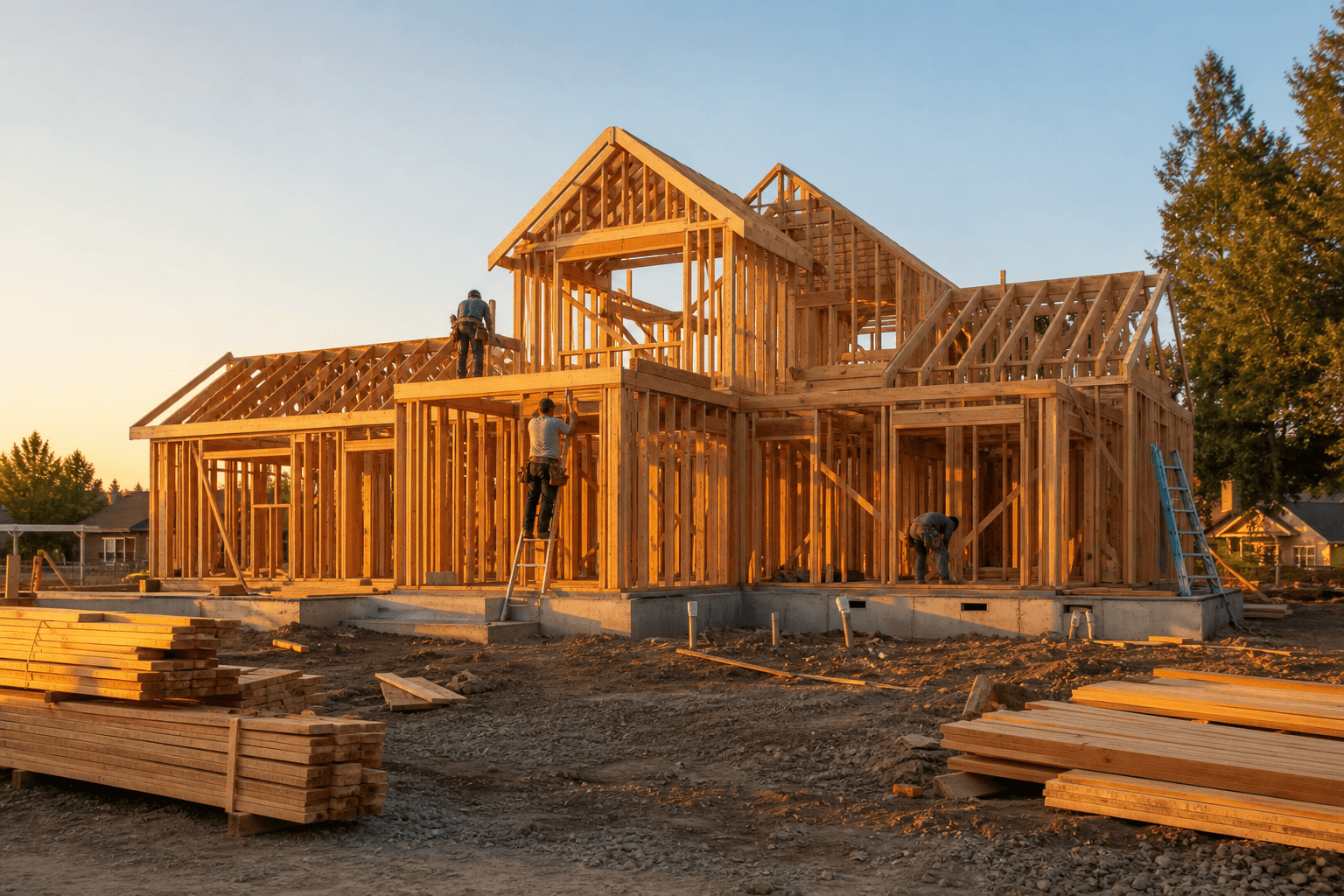
Framing is when your home takes shape. This is the phase clients get most excited about because progress is highly visible — you go from a flat slab to a three-dimensional structure in a matter of weeks.
Wall framing — First-floor walls go up, followed by second-floor deck (if applicable) and second-floor walls. The framing crew works from the ground up.
Roof framing — Trusses or rafters are set, sheathing is applied, and the roof structure is completed. Complex rooflines with multiple ridges, valleys, and dormers take longer than simple gable designs.
Windows and exterior doors — Installed during or immediately after framing to protect the interior from weather.
Sheathing and house wrap — OSB or plywood sheathing is applied to wall framing, followed by a weather-resistive barrier (house wrap like Tyvek or ZIP System sheathing).
The framing inspection verifies structural integrity, proper fastening, and code compliance before mechanical rough-ins begin.
Phase 4: Mechanical Rough-Ins (3 to 5 Weeks)
With the house framed and dried in (roof and house wrap in place), the mechanical trades move in to install systems inside the walls before drywall closes everything up.
Electrical Rough-In (1 to 2 Weeks)
All wiring, outlet boxes, switch boxes, and panel connections are installed. This includes structured wiring for networking and smart home systems, dedicated circuits for kitchen appliances, and specialty wiring for EV chargers or hot tubs.
Plumbing Rough-In (1 to 2 Weeks)
Water supply lines, drain lines, and vent stacks are installed within the wall and floor framing. The location of every fixture — sink, toilet, tub, shower, hose bib — is roughed in during this phase.
HVAC Rough-In (1 to 2 Weeks)
Ductwork, refrigerant lines, and equipment pads are installed. In North Carolina, proper duct sizing and sealing are critical for both comfort and energy code compliance. We verify duct leakage testing before moving forward.
These three trades overlap to some extent, but proper sequencing prevents conflicts. Our project managers create a coordination schedule so electricians, plumbers, and HVAC crews are not tripping over each other.
After mechanical rough-ins are complete, the county performs rough-in inspections for each trade before insulation and drywall can proceed.
Phase 5: Insulation and Drywall (3 to 4 Weeks)
Insulation (3 to 5 Days)
Depending on the specifications, insulation may include fiberglass batts in walls, blown-in cellulose or fiberglass in the attic, and rigid foam board at specific locations. Energy code compliance is verified through insulation inspection and may include a blower door test.
Drywall (2 to 3 Weeks)
Drywall installation includes hanging sheets on walls and ceilings, taping and mudding joints, and sanding to a smooth finish. This is a three-step process — first coat, second coat, and finish coat — with drying time between each. Temperature and humidity affect drying time, which is why drywall work during hot, humid North Carolina summers requires careful climate management.
Phase 6: Interior Finishes (6 to 10 Weeks)
This is the longest phase and the one with the most moving parts. Interior finishes include:
Painting — Primer and two coats of paint on all walls, ceilings, and trim. Typically 1 to 2 weeks.
Cabinetry — Kitchen cabinets, bathroom vanities, and any built-in millwork are installed. Lead times for custom cabinetry can be 8 to 12 weeks, which is why ordering early in the process is critical.
Countertops — Templated after cabinet installation, then fabricated and installed. Allow 2 to 3 weeks from templating to installation.
Flooring — Hardwood, tile, LVP, or carpet depending on the room. Flooring installation typically takes 1 to 2 weeks for the whole house.
Trim and millwork — Baseboards, crown molding, casing, and interior door installation. This detail work takes 1 to 2 weeks.
Plumbing and electrical trim — Fixtures, outlets, switches, and covers are installed. Faucets, toilets, showerheads, light fixtures, and appliances go in during this phase.
Phase 7: Exterior Finishes (Concurrent with Interior)
While interior work progresses, exterior finishes are completed:
Siding installation — Fiber cement, brick, stone, or the selected exterior material
Roofing — Final roofing installation if not completed during framing dry-in
Gutters and downspouts
Driveway and walkways — Concrete or paver installation
Landscaping — Grading, sod, plantings, and irrigation
Exterior paint or stain
Phase 8: Final Inspections and Walkthrough (1 to 2 Weeks)
The final push includes:
Final building inspection — The county inspector verifies code compliance across all trades.
Certificate of Occupancy (CO) — Issued by the county once all inspections pass. You cannot legally move in without a CO.
Builder walkthrough — We walk every inch of the home with you, creating a punch list of any items that need correction.
Punch list completion — Typically 3 to 5 business days to address minor touch-ups, adjustments, and cosmetic items.
Closing and key handover — The final step. Welcome home.
Tips for Keeping Your Build on Schedule
Make selections early — The number one cause of delays is waiting on client decisions for materials, colors, or fixtures. Make as many selections as possible before construction begins.
Communicate consistently — Regular check-ins with your builder prevent surprises. We provide weekly progress updates and photo documentation throughout construction.
Trust the process — There will be weather delays, inspection holds, and the occasional material lead time issue. A good builder manages these proactively rather than reactively.
Avoid major changes mid-build — Change orders during construction are expensive and time-consuming. Finalize your design before breaking ground.
Build with a Team That Respects Your Time
South Eastern General Contractors has been delivering custom homes on time and on budget in Fayetteville for over 21 years. Our project management process, established subcontractor relationships, and proactive communication keep your build moving forward without surprises.
Contact us at (910) 565-4719 or visit southeasterngc.com to start planning your custom home.

South Eastern General Contractors
South Eastern General Contractors is a Native American-owned, 8(a) and HUBZone certified construction firm with over 21 years of proven results across Fayetteville, Lumberton, and the surrounding North Carolina communities. We build legacies, not just structures.
Ready to Build With Clarity and Confidence?
Your project deserves more than a contractor who just shows up and starts building. We guide you through a professional design-build process built around clear plans, detailed selections, documented scopes, and construction checklists that help eliminate confusion, mistakes, and missed expectations.
Other Blogs