Blog
Concrete Slab Foundations in NC: What Every Homeowner Should Know Before They Build
Published
Category
Construction Guides
Most custom homes in eastern NC are built on concrete slabs. Here's what homeowners need to know about slab design, vapor barriers, reinforcement, and what goes into a quality pour.
Your Entire Home Rests on This One Pour
The concrete slab foundation is the most common foundation type for residential construction in eastern North Carolina — and for good reason. The region's relatively flat terrain, high water tables in some areas, and sandy-to-clay soil conditions make slab-on-grade the most practical and cost-effective foundation choice for most custom homes in the Fayetteville, Fort Bragg, and surrounding areas.
But "most common" doesn't mean "simple." A concrete slab foundation involves soil preparation, moisture management, reinforcement, proper concrete mix design, and careful finishing — all coordinated in a single continuous pour that can't be undone once it hardens. At South Eastern General Contractors, we've poured hundreds of slab foundations across Cumberland, Hoke, and Robeson Counties over the past 21+ years. Here's what homeowners should understand about what's going under their home.
Types of Slab Foundations Used in NC
Monolithic Slab (Thickened Edge)
The most common type in our area. The slab and the perimeter footing are poured as a single, continuous pour. The perimeter edge is thickened (typically 12-18" deep and 12" wide) to serve as the footing, while the interior slab is typically 4" thick. This is faster and more economical than a stem wall foundation because it eliminates the separate footing pour and block wall construction.
Stem Wall Foundation with Slab
A traditional two-phase approach: first, a continuous footing is poured, then concrete block (CMU) stem walls are laid on the footing to the desired floor height, then the slab is poured inside the stem walls. This method is used when the grade change requires the floor height to be elevated above the surrounding grade (common on sloped lots or in flood zones). More expensive than monolithic, but provides more flexibility for grade changes and allows for deeper footings on challenging soil.
Post-Tensioned Slab
A specialized slab design where high-strength steel cables (tendons) are embedded in the concrete and tensioned after the concrete cures. This creates a pre-stressed slab that resists cracking and can span over variable soil conditions without additional footings. Post-tensioned slabs are less common in our area but are used on large commercial projects and on residential lots with expansive clay soils.
Site Preparation: What Happens Before the Pour
The foundation is only as good as the ground it sits on. Site preparation for a slab foundation in the Fayetteville area typically includes:
Soil Testing
A geotechnical engineer takes soil borings at the building site to determine the soil's bearing capacity (how much weight it can support) and identify any issues — organic layers, high water tables, expansive clay, or fill material. The geotechnical report drives the foundation design: footing depth, slab thickness, reinforcement requirements, and whether any soil improvement (compaction, over-excavation and replacement) is needed.
Rough Grading and Compaction
The building pad is cleared, stripped of topsoil, and graded to the design elevation. If fill material is needed to bring the pad to grade, it's placed in lifts (typically 8-12" layers) and mechanically compacted to 95% Standard Proctor density. A compaction test verifies the fill meets the required density. Improperly compacted fill is the #1 cause of slab settlement and cracking — if the soil under the slab compresses unevenly over time, the slab moves with it.
Plumbing Rough-In (Under-Slab)
Before the slab is poured, all under-slab plumbing — drain lines, water supply lines (in some cases), and any radiant heating tubing — must be installed, inspected, and pressure-tested. Once the concrete goes over it, these lines are encased and inaccessible without jackhammering. This is why plan changes to kitchen and bathroom layouts after the slab is poured are so expensive — you're cutting into the foundation to relocate plumbing.
Vapor Barrier
A polyethylene vapor barrier (minimum 10 mil, though 15 mil is increasingly standard) is placed over the compacted subgrade, under the slab. This prevents ground moisture from migrating up through the concrete and into the living space. In the Fayetteville area's humid climate with relatively high water tables in some neighborhoods, a proper vapor barrier is essential for long-term floor finish performance — especially for hardwood floors, LVP, and carpet that can be damaged by moisture vapor.
The vapor barrier should be lapped at seams (minimum 6" overlap) and sealed with vapor barrier tape. It should also extend up the sides of the footing forms to create a continuous moisture barrier on the bottom and edges of the slab.
Reinforcement
Concrete is strong in compression (it handles weight well) but weak in tension (it cracks when pulled apart). Reinforcement — steel rebar and/or welded wire fabric — provides the tensile strength that concrete lacks.
A typical residential slab in our area uses:
#4 rebar (1/2" diameter) at 18-24" on center, both directions — forming a grid in the slab
#4 or #5 rebar in the thickened edge footing — typically 2-3 bars running continuously around the perimeter, with vertical dowels if a stem wall will be built on top
Rebar chairs — plastic or metal supports that hold the rebar grid at the correct height within the slab thickness (typically centered in a 4" slab, meaning 2" from the bottom)
The reinforcement needs to be at the right height — rebar sitting on the ground does nothing. It needs to be elevated into the concrete cross-section where it can resist the tensile stresses that cause cracking. Inspectors check rebar placement height during the pre-pour inspection.
The Pour: What Happens on Pour Day
Pour day is one of the biggest milestones in any build — and one of the most time-sensitive. Concrete has a finite working time (typically 60-90 minutes depending on temperature, mix design, and admixtures), and the entire slab needs to be placed, consolidated, struck off, and finished before it starts to set.
Concrete Mix Design
The structural plans specify the concrete mix: typically 3,000-4,000 PSI compressive strength, with a 4-5" slump (a measure of workability). In the Fayetteville area, most ready-mix suppliers deliver a standard 3,500 PSI residential mix. Fiber reinforcement (synthetic micro-fibers mixed into the concrete) is sometimes specified in addition to rebar to reduce plastic shrinkage cracking during the cure.
Placement and Consolidation
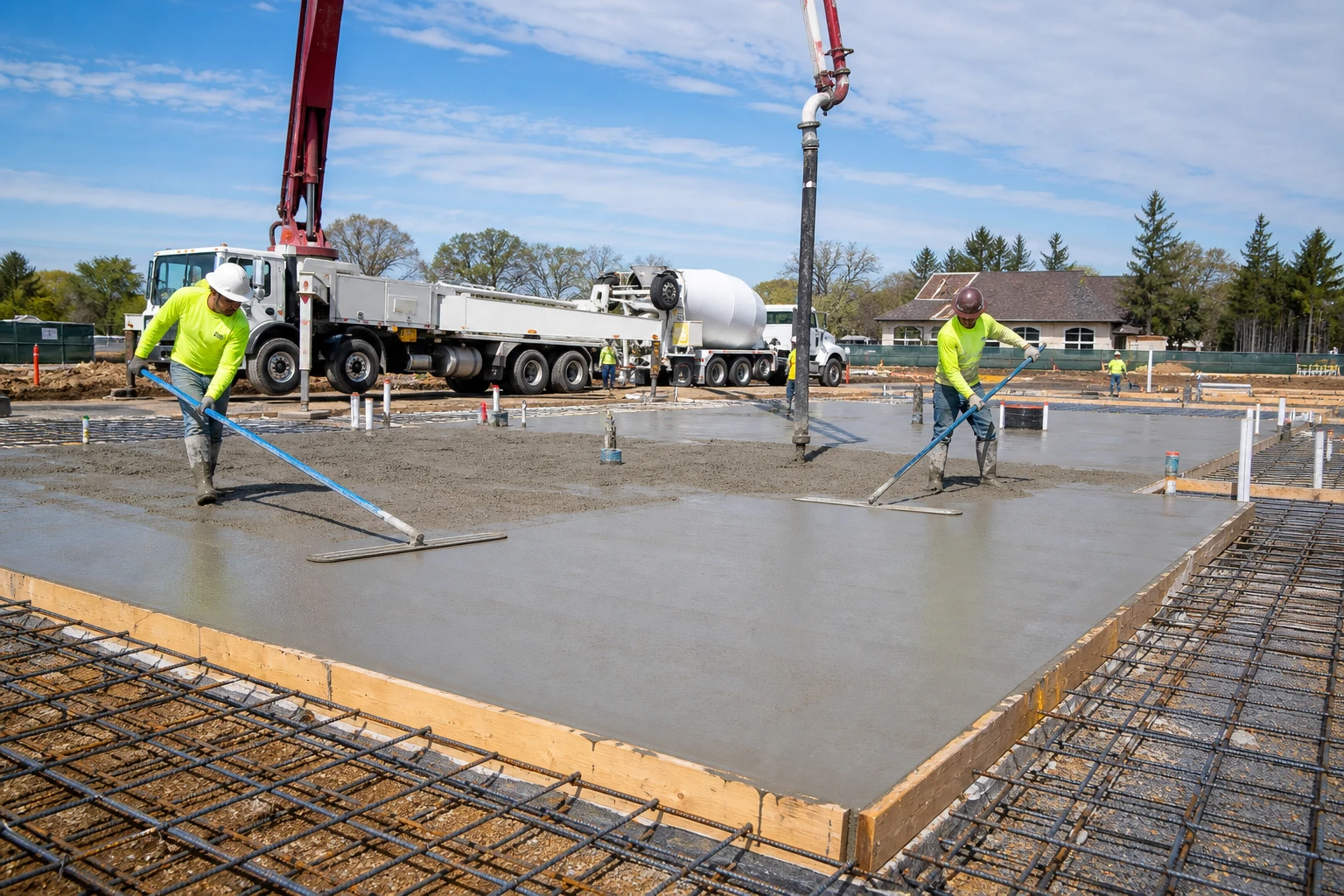
Concrete is delivered by ready-mix trucks and placed directly into the forms (for smaller pours) or pumped via a boom pump or line pump (for larger pours or sites where truck access is limited). As concrete is placed, workers use vibrators to consolidate it — eliminating air pockets and ensuring the concrete fully surrounds the rebar and fills the forms without voids.
Finishing
After the concrete is struck off (leveled with a screed board) and bull-floated (smoothed with a large flat tool), it goes through several finishing passes:
Bull float or Fresno — initial smoothing pass, closes the surface and pushes aggregate below the cream
Wait for bleed water to evaporate — this is critical. Finishing over bleed water traps moisture beneath the surface and creates a weak, dusting surface layer
Power trowel or hand trowel — final finishing passes that compress and smooth the surface to the desired texture
Broom finish (if specified) — a texture dragged across the surface for traction on garage slabs, porches, and walkways
Curing: The Most Overlooked Step
Concrete doesn't "dry" — it cures. The chemical reaction (hydration) between cement and water that gives concrete its strength needs moisture and time. A slab that dries out too quickly will be weaker, more prone to cracking, and have a softer surface than one that's properly cured.
Proper curing in the Fayetteville climate means:
Curing compound applied within 30 minutes of finishing — a spray-on membrane that seals moisture in the slab
No traffic for at least 24 hours — foot traffic should be avoided for one full day, vehicle traffic for 7 days minimum
28-day cure for full strength — concrete reaches its specified compressive strength (3,500 PSI) at 28 days. Framing can typically begin at 7 days (when the slab reaches approximately 65-75% of its design strength)
Common Slab Problems and How to Prevent Them
Cracking — some cracking in concrete is normal and expected. Control joints (saw-cut or tooled grooves) are placed to control where cracks form — they create weak planes that encourage cracking along the joint line rather than randomly across the slab. A 4" slab should have control joints at maximum 10-12 foot intervals in both directions.
Settlement — caused by improperly compacted fill or organic material left under the slab. Prevention: proper site prep, compaction testing, and removal of all organic material.
Moisture vapor — caused by missing or damaged vapor barrier. Prevention: 15 mil vapor barrier, properly lapped and sealed, inspected before the pour.
Surface defects — dusting, scaling, or spalling caused by finishing over bleed water, adding water to the surface during finishing, or freeze-thaw exposure before curing is complete. Prevention: experienced finishers, proper curing compound, and weather monitoring.
What Homeowners Should Ask Their Builder
What PSI concrete mix are you specifying for the slab? (3,500 PSI minimum for residential)
What vapor barrier thickness and brand are you using? (15 mil recommended)
What rebar reinforcement is in the slab? (Request the structural drawing)
Do you use rebar chairs to elevate the reinforcement? (Yes is the only acceptable answer)
How do you handle curing? (Curing compound at minimum; wet curing is even better)
Will a geotechnical soil test be performed? (Required for any responsible builder)
Build on a Solid Foundation with SEGC
At South Eastern General Contractors, the foundation is where accountability begins. Every slab we pour starts with proper site testing, engineered reinforcement, and a crew that understands what separates a foundation that lasts from one that doesn't. With 21+ years of custom home building in Fayetteville and the surrounding NC communities, and as a Native American-owned, 8(a) and HUBZone certified firm, we don't cut corners on the one thing your entire home depends on.
Ready to build on solid ground? Contact SEGC at (910) 565-4719 or visit southeasterngc.com.

South Eastern General Contractors
South Eastern General Contractors is a Native American-owned, 8(a) and HUBZone certified construction firm with over 21 years of proven results across Fayetteville, Lumberton, and the surrounding North Carolina communities. We build legacies, not just structures.
Ready to Build With Clarity and Confidence?
Your project deserves more than a contractor who just shows up and starts building. We guide you through a professional design-build process built around clear plans, detailed selections, documented scopes, and construction checklists that help eliminate confusion, mistakes, and missed expectations.
Other Blogs