Blog
Brick and Masonry Steps on Custom Homes: Design Options, Process, and What to Expect
Published
Category
Construction Guides
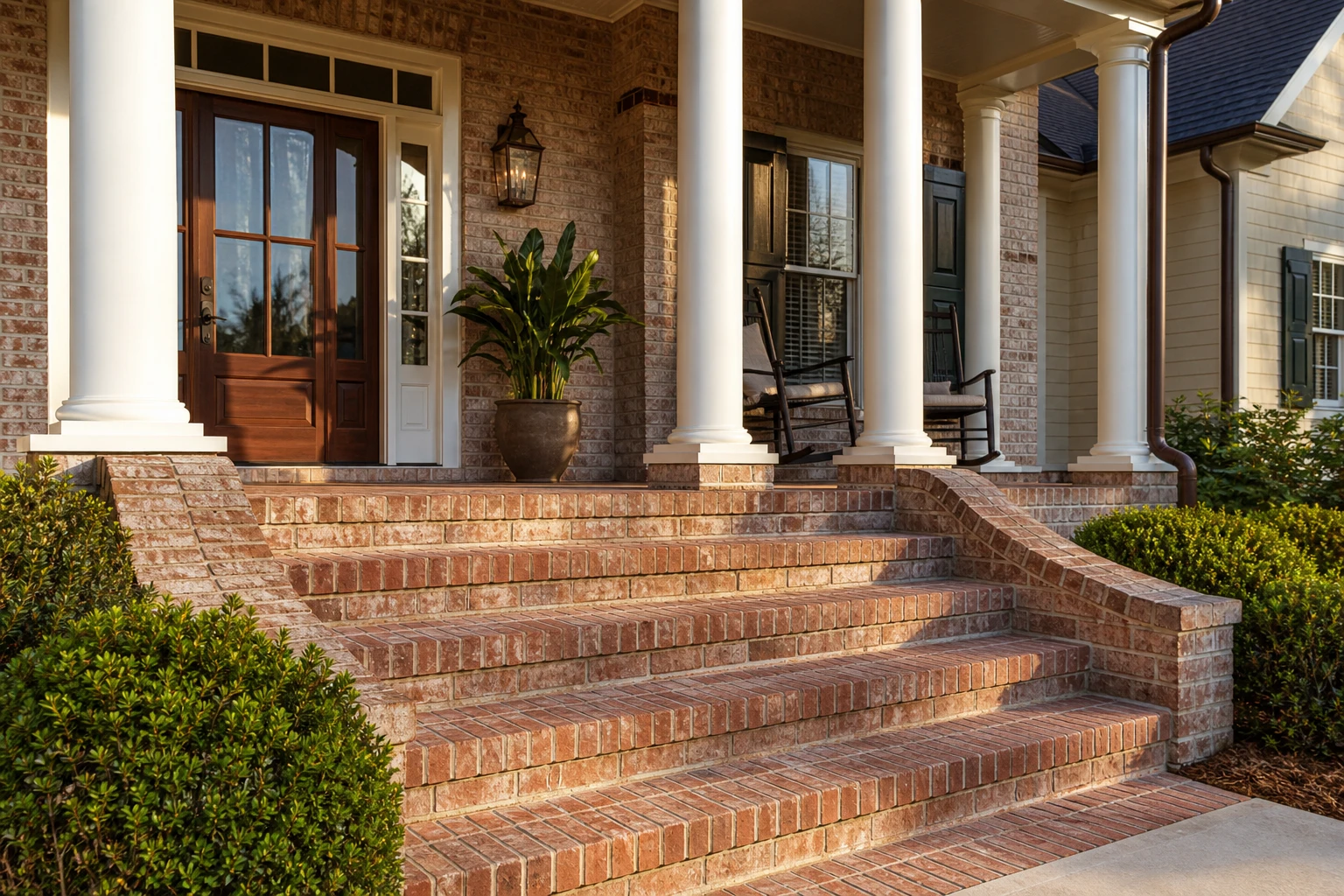
Thinking about brick or concrete masonry entry steps for your custom home? Learn the design options, footing requirements, solid vs. hollow construction, and what to budget.
The Front Steps Set the Tone for Your Entire Home
Walk up to any custom home and the first thing you physically interact with is the front steps. Before you touch the door handle, before you step onto the porch, you're standing on the entry steps. They're one of the most visible elements of your home's exterior — and one of the most structurally critical. Get them right, and they frame the entrance beautifully for decades. Get them wrong, and you're looking at cracking, settling, and a rebuild within ten years.
At South Eastern General Contractors, we build brick and masonry steps on virtually every custom home we construct in the Fayetteville and Fort Bragg area. We've worked with every configuration — solid brick treads, concrete masonry unit (CMU) cores with brick veneer, poured concrete with stone caps, and everything in between. Here's what homeowners need to know about the process, the options, and what makes the difference between steps that last and steps that don't.
Solid Brick vs. CMU Core: Understanding the Two Main Approaches
When most homeowners think of "brick steps," they picture solid brick construction — courses of brick stacked and mortared to form each step. That's one approach, but it's not the only one, and it's not always the best choice. The two primary methods are:
Solid Brick Construction
This is the traditional approach. Each step is built entirely from solid bricks or solid pavers, laid in courses with mortar joints. The treads (the flat surface you step on) are typically solid brick or brick pavers, and the risers (the vertical face of each step) are brick as well. This method produces a beautiful, solid-mass result, but it requires more material, more labor, and a more substantial footing to support the weight.
Solid brick steps work best for shorter runs — two or three steps up to a porch. For taller step assemblies (four steps or more), the weight and material cost increase significantly, and a CMU core approach often makes more sense structurally and economically.
CMU Core with Brick Veneer
This is the more common approach for custom homes with taller entry sequences. Concrete masonry units (CMU blocks — the gray cinder blocks you've seen on every construction site) are laid to form the structural core of the steps. Then brick veneer is applied to the visible faces — the risers, cheek walls, and sometimes the treads. The treads can be brick, stone, or poured concrete with a broom finish.
This method is structurally stronger than solid brick for taller assemblies, costs less in material, and allows for more design flexibility. The CMU core can be filled with grout and rebar for additional strength, and it provides a consistent substrate for the brick veneer to bond to.
Footing Requirements: The Foundation Under Your Steps
This is where many builders cut corners, and it's where problems start. Brick and masonry steps are heavy — a four-step entry with cheek walls can weigh 3,000-5,000 pounds. That weight needs to sit on a proper footing, not on backfill, not on compacted dirt, and definitely not on the edge of the house slab.
In Cumberland County and the surrounding Fayetteville area, the soil conditions vary significantly. Sandy soils near the Cape Fear River drain well but don't always provide great bearing capacity. Clay soils in the Seventy-First and Anderson Creek areas can expand and contract with moisture changes, causing frost heave and settlement.
A proper step footing in this area typically includes:
Minimum 12" depth below grade — below the frost line (which is approximately 10" in zone 3, but 12" provides margin)
Minimum 12" width wider than the step assembly — 6" on each side
6" thick minimum of reinforced concrete — with #4 rebar on 16" centers in both directions
Compacted stone base — 4-6" of compacted #57 stone or crusher run beneath the footing
Dowel connection to the house slab or foundation wall — epoxied rebar dowels tying the step footing to the house foundation prevent the steps from separating and settling away from the building over time
That last point is critical. One of the most common step failures we see on existing homes is a gap developing between the steps and the house. The steps were built on their own independent footing with no connection to the house foundation, and over time they settle differentially and pull away. You end up with a 1-2" gap that collects water, debris, and creates a trip hazard.
Design Options and What Works in North Carolina
Brick steps aren't one-size-fits-all. The design should complement your home's architecture, match the brick selection, and account for the local climate. Here are the most popular configurations we build in the Fayetteville area:
Full-Width Steps with Cheek Walls
This is the classic custom home entry. The steps span the full width of the porch opening (typically 6-10 feet), with brick cheek walls on each side that taper down from porch height to grade. The cheek walls can be capped with stone, precast concrete, or brick soldier course. Columns or posts on the cheek walls can support a porch roof overhang. This is the most common configuration on SEGC custom homes with covered front porches.
Flanking Steps with Landing
For taller entries (4+ steps), a mid-run landing breaks the climb and adds architectural interest. The landing is typically 4x4 or 4x6 feet and can be brick, stone, or stamped concrete. Steps continue from the landing to grade level, often turning 90 degrees. This configuration works well for homes with significant grade changes — common in the rolling terrain of Hoke County and southern Cumberland County.
Curved or Radiused Steps
Curved brick steps add elegance and soften the geometry of the entry. The treads and risers follow a consistent radius, fanning out from the porch to the walkway. This is a premium option that requires more skilled labor — each brick on the curved face needs to be cut to follow the radius, and the mortar joints need to be consistent despite the changing angles. When done well, it's one of the most striking entry treatments you can build.
Brick Tread Details
The tread surface itself has several options:
Brick pavers (flat-laid) — The most common and economical choice. Standard brick pavers are laid flat with mortar joints on the tread surface.
Bullnose brick — Rounded-edge bricks on the front edge of each tread. Creates a finished, softened look and reduces chipping.
Soldier course edging — Bricks stood on end along the front edge of each tread, with field brick behind. A classic detail.
Stone tread caps — Bluestone, flagstone, or granite caps over CMU risers. A premium look that pairs well with brick cheek walls.
The Build Process: What to Expect
Building brick or masonry steps on a custom home typically happens in three phases:
Phase 1: Foundation and Core (Week 1)
The step footing is poured, typically at the same time as the house slab or within a few days. After the footing cures (minimum 3 days, ideally 7), the CMU core or solid brick core is laid. If using CMU, the cells are grouted and rebar is placed per the structural plan. The core is left to cure for at least 48 hours before brick veneer begins.
Phase 2: Brick Veneer and Treads (Week 2-3)
The mason applies brick veneer to the visible faces of the CMU core, matching the house brick in pattern, color, and mortar joint style. Treads are installed — whether brick pavers, stone caps, or poured concrete with a broom finish. Mortar joints are tooled to match the house. Cheek wall caps are set.
Phase 3: Finishing and Grading (Week 3-4)
The grade around the steps is backfilled and compacted, ensuring positive drainage away from the foundation. Any brick sealer is applied if specified. Walkway connections (concrete, pavers, or stone) are completed to tie the steps into the overall landscape.
Common Mistakes to Avoid
No footing or inadequate footing — Steps built directly on backfill will settle within 2-3 years
No connection to house foundation — Steps will eventually separate and pull away from the building
Mismatched brick — Using a different brick lot or different mortar color on the steps vs. the house is immediately visible
Inconsistent riser heights — Building code requires uniform riser heights (max 7.75" per the IRC, with no more than 3/8" variation between risers). Uneven risers are a trip hazard and will fail inspection.
No slope on treads — Each tread should slope slightly forward (1/4" per foot) for water drainage. Flat or backward-sloping treads pool water, which leads to ice in winter and accelerated mortar deterioration.
What to Budget
Brick and masonry step pricing varies significantly based on the scope. As a general guide for the Fayetteville area in 2026:
Basic 3-step entry with CMU core and brick veneer: $3,500-$6,000
Full-width entry with cheek walls (4-5 steps): $8,000-$15,000
Curved or radiused steps: $12,000-$20,000+
Stone tread caps (add-on): $2,000-$5,000 depending on stone type
These ranges include the footing, core construction, brick veneer, and finishing but not the walkway or landscaping connections.
Build It Right the First Time
Your front steps will be used thousands of times over the life of your home. They'll handle rain, ice, foot traffic, and the full weight of every person and piece of furniture that enters your house. At South Eastern General Contractors, we've been building custom homes with lasting brick and masonry details in Fayetteville and the surrounding North Carolina communities for over 21 years. As a Native American-owned, 8(a) and HUBZone certified firm, we bring the credentials and the craftsmanship to do it right.
Ready to start planning your custom home? Contact SEGC at (910) 565-4719 or visit southeasterngc.com to schedule a consultation.

South Eastern General Contractors
South Eastern General Contractors is a Native American-owned, 8(a) and HUBZone certified construction firm with over 21 years of proven results across Fayetteville, Lumberton, and the surrounding North Carolina communities. We build legacies, not just structures.
Ready to Build With Clarity and Confidence?
Your project deserves more than a contractor who just shows up and starts building. We guide you through a professional design-build process built around clear plans, detailed selections, documented scopes, and construction checklists that help eliminate confusion, mistakes, and missed expectations.
Other Blogs