Blog
Blower Door Test Results: What the ACH50 Number Actually Means
Published
Category
Construction Guides
Learn what ACH50 means, what a good score looks like for NC homes, and why your blower door test result matters more than you think for energy bills and comfort.
Why Your Blower Door Test Result Matters More Than You Think
If you're building a new home in North Carolina, you'll hear the phrase "blower door test" at least once during the process. Your builder will schedule it, your inspector will require it, and at some point someone will hand you a number — your ACH50 — and tell you whether your house "passed." But what does that number actually mean? And why should you care?
At South Eastern General Contractors, we've run hundreds of blower door tests across our custom homes in the Fayetteville area. We've seen scores as tight as 1.5 ACH50 and we've seen what happens when builders cut corners on air sealing. The difference shows up in your energy bills, your comfort, and the long-term health of your home. Here's what every homeowner should understand about blower door testing.
What Is a Blower Door Test?
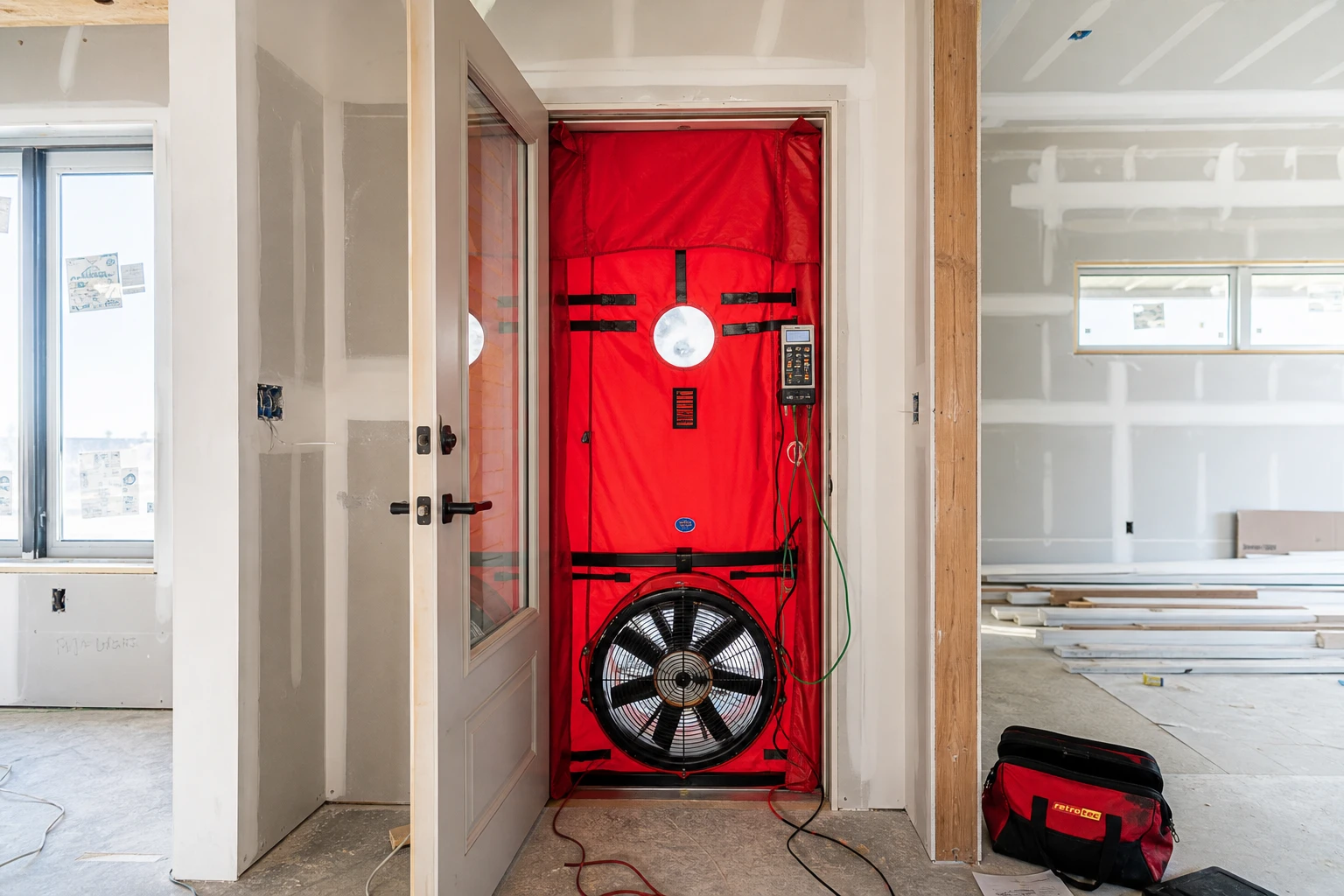
A blower door test measures how airtight your home is. A calibrated fan is mounted in an exterior door frame, and it depressurizes the house — essentially pulling air out and measuring how much air leaks back in through cracks, gaps, and penetrations in the building envelope.
The fan creates a pressure difference of 50 Pascals (roughly equivalent to a 20 mph wind hitting every surface of the house simultaneously). Under that pressure, air leaks through every gap, crack, and unsealed penetration in the building envelope. The fan's software measures the total volume of air flowing through those leaks and calculates your ACH50 score.
What Does ACH50 Mean?
ACH50 stands for Air Changes per Hour at 50 Pascals. It tells you how many times the entire volume of air inside your home is replaced by outside air in one hour, under the artificial 50 Pascal test pressure.
For example, if your home measures 4.0 ACH50, that means under test conditions, the full air volume of your house leaks out and is replaced four times per hour. A lower number means a tighter house. A higher number means more air is escaping.
Here's how to think about it in practical terms:
7.0 ACH50 — The maximum allowed under the 2018 NC Residential Code for climate zones 3 and 4 (which covers most of North Carolina, including Fayetteville and Cumberland County)
5.0 ACH50 — Average for a well-built production home
3.0 ACH50 — What a quality custom builder should consistently hit
2.0 ACH50 or lower — High-performance construction, approaching passive house territory
1.0 ACH50 — Exceptional. This is passive house certification range
What North Carolina Code Requires
The North Carolina Residential Code, which follows the 2018 IRC with amendments, sets the maximum air leakage at 5.0 ACH50 for climate zone 4 (which includes the western NC mountains) and 5.0 ACH50 for zone 3 (the rest of the state, including Fayetteville, Raleigh, and the coast). Some jurisdictions and energy programs still reference the older 7.0 threshold, but the 2018 code tightened it.
Meeting code is the minimum. It means your house won't fail inspection, but it doesn't mean your house is particularly tight. Think of it like a passing grade on a test — a D+ gets you through, but it's not what you want for your custom dream home.
What Affects Your ACH50 Score
Air leakage happens at every penetration, seam, and transition in your building envelope. The biggest offenders in residential construction are:
Bottom plate to slab or subfloor connection — If the sill plate isn't sealed to the foundation with gasket tape or caulk, air pours in at the base of every wall
Top plate to ceiling connection — Where interior partition walls meet the ceiling plane, there's often a gap that lets conditioned air escape into the attic
Electrical penetrations — Every outlet, switch box, and recessed light that penetrates an exterior wall or ceiling is a leak point
Plumbing penetrations — Drain lines, supply lines, and vent stacks that pass through the building envelope need to be sealed with fire-rated caulk or foam
HVAC duct penetrations — Supply and return duct boots, especially in unconditioned attics, are major leak sources
Window and door rough openings — The gap between the window unit and the rough framing needs to be sealed with low-expansion foam, not stuffed with fiberglass
Rim joist and band board areas — In homes with crawl spaces, the rim joist area where the floor system meets the foundation wall is one of the leakiest zones
Fireplace chases — Gas fireplace framing and chimney penetrations are notoriously leaky
When Is the Blower Door Test Done?
In North Carolina, the blower door test is typically performed at two points during construction:
Pre-drywall (rough-in stage): This is the most valuable test. At this point, framing is complete, windows and doors are installed, and the building envelope is closed in — but drywall hasn't been hung yet. You can see exactly where air is leaking and fix it before the walls are closed up. We use a smoke pencil or theatrical fog to trace leak paths during this test. If there's a problem, it's a $50 can of foam fix, not a $5,000 drywall tear-out.
Final (post-drywall): This is the code-required test. It happens after drywall, painting, and trim are complete but before the final mechanical inspection. The drywall itself acts as an air barrier, so scores typically improve by 1.0-2.0 ACH50 from the pre-drywall test. This is the number that goes on the inspection report.
What a Good Score Looks Like at Each Stage
Based on our experience building custom homes in the Fayetteville and Fort Bragg area, here's what we typically see:
Pre-drywall target: 4.0-5.0 ACH50 (knowing drywall will tighten it by 1-2 points)
Final test target: 2.5-3.5 ACH50 for a quality custom home
What we consistently deliver: 2.0-3.0 ACH50 on SEGC custom homes
If your builder is telling you that 5.0 or 6.0 ACH50 is "a great score," that's a red flag. It passes code, but it's not indicative of careful air sealing work. A builder who is intentional about air sealing — using gasket tape at plate lines, foam at penetrations, and proper window flashing — should be consistently under 3.5 on the final test.
How ACH50 Affects Your Energy Bills
Every point of ACH50 matters. Studies from the Department of Energy show that air leakage accounts for 25-40% of the energy used for heating and cooling in a typical home. In North Carolina's climate — hot, humid summers and moderately cold winters — that translates directly to your Duke Energy bill.
A rough rule of thumb: for a 2,500 square foot home in zone 3, each 1.0 reduction in ACH50 saves approximately $150-$250 per year in heating and cooling costs. Over a 30-year mortgage, that's $4,500-$7,500 per point. A home built to 2.5 ACH50 instead of 5.0 ACH50 could save $12,000-$18,000 in energy costs over its lifetime.
Beyond Energy: Comfort and Durability
Energy savings are important, but they're not the whole story. A tighter building envelope also means:
Fewer drafts. Cold spots near windows and exterior walls are almost always caused by air leakage, not insulation failure. Seal the leaks and the drafts disappear.
Better humidity control. In Fayetteville's humid summers, uncontrolled air infiltration brings moisture into the building envelope. That moisture condenses on cool surfaces and can lead to mold, rot, and structural damage over time. A tight envelope with proper mechanical ventilation controls moisture far better than a leaky house that "breathes."
Quieter interior. Air leak paths are also sound transmission paths. Tighter homes are noticeably quieter, especially near roads or military flight paths around Fort Bragg.
Better indoor air quality. When you control where air enters your home (through filtered mechanical ventilation), you control what comes in with it — pollen, dust, exhaust, radon. A leaky house pulls unfiltered air through crawl spaces, attics, and wall cavities.
The "Too Tight" Myth
One of the most persistent myths in residential construction is that a house can be "too tight" and that it "needs to breathe." This is outdated thinking from an era before mechanical ventilation was standard. A house does need fresh air — but it should come through a controlled, filtered system (like an ERV or HRV), not through random cracks in the floor and ceiling.
The building science community settled this debate decades ago: build tight, ventilate right. Seal the envelope as tight as you can, then install the right mechanical ventilation system to provide fresh air at a controlled rate. This is why SEGC installs energy recovery ventilators (ERVs) on every custom home — they provide fresh air while recovering 70-80% of the energy from the exhaust air.
What to Ask Your Builder
If you're planning a custom home in North Carolina, here are the questions to ask your builder about air sealing:
What ACH50 do you typically achieve on your final blower door tests?
Do you perform a pre-drywall blower door test? (If not, why not?)
What air sealing methods do you use at plate lines, penetrations, and window rough openings?
Do you install mechanical ventilation (ERV/HRV) in your homes?
Can I see blower door test results from your recent projects?
A builder who can't answer these questions — or who dismisses air sealing as unimportant — is not building to the standard your investment deserves.
Build Tight with SEGC
At South Eastern General Contractors, energy performance isn't an afterthought — it's built into our process from the foundation up. With over 21 years of custom home building experience in Fayetteville and the surrounding communities, we've refined our air sealing methods to consistently deliver homes in the 2.0-3.0 ACH50 range. Our 8(a) and HUBZone certifications reflect our commitment to accountability and quality, and our 120+ five-star Google reviews speak to the results.
Ready to build a home that performs as good as it looks? Contact South Eastern General Contractors at (910) 565-4719 or visit southeasterngc.com to start the conversation.

South Eastern General Contractors
South Eastern General Contractors is a Native American-owned, 8(a) and HUBZone certified construction firm with over 21 years of proven results across Fayetteville, Lumberton, and the surrounding North Carolina communities. We build legacies, not just structures.
Ready to Build With Clarity and Confidence?
Your project deserves more than a contractor who just shows up and starts building. We guide you through a professional design-build process built around clear plans, detailed selections, documented scopes, and construction checklists that help eliminate confusion, mistakes, and missed expectations.
Other Blogs